Fetch and analyze South Carolina school enrollment data from the South Carolina Department of Education (SCDE) in R or Python. Over a decade of data (2013-2025) for every school, district, and the state – nearly 800,000 students across 80 districts.
Part of the state schooldata project, inspired by njschooldata – the original package that started this effort to make state education data accessible.
Full documentation – all 15 stories with interactive charts, getting-started guide, and complete function reference.
Highlights
library(scschooldata)
library(dplyr)
library(tidyr)
library(ggplot2)

theme_set(theme_minimal(base_size = 14))
1. Kindergarten has not recovered from COVID
Kindergarten enrollment dropped sharply during the pandemic and has not returned to pre-pandemic levels, declining each year since a partial rebound in 2022.
k_enr <- fetch_enr_multi(2019:2025, use_cache = TRUE)

k_trends <- k_enr |>
  filter(is_state, subgroup == "total_enrollment", grade_level == "K") |>
  select(end_year, n_students) |>
  mutate(
    change_from_2019 = n_students - first(n_students),
    pct_change = round(change_from_2019 / first(n_students) * 100, 1)
  )
stopifnot(nrow(k_trends) > 0)

k_trends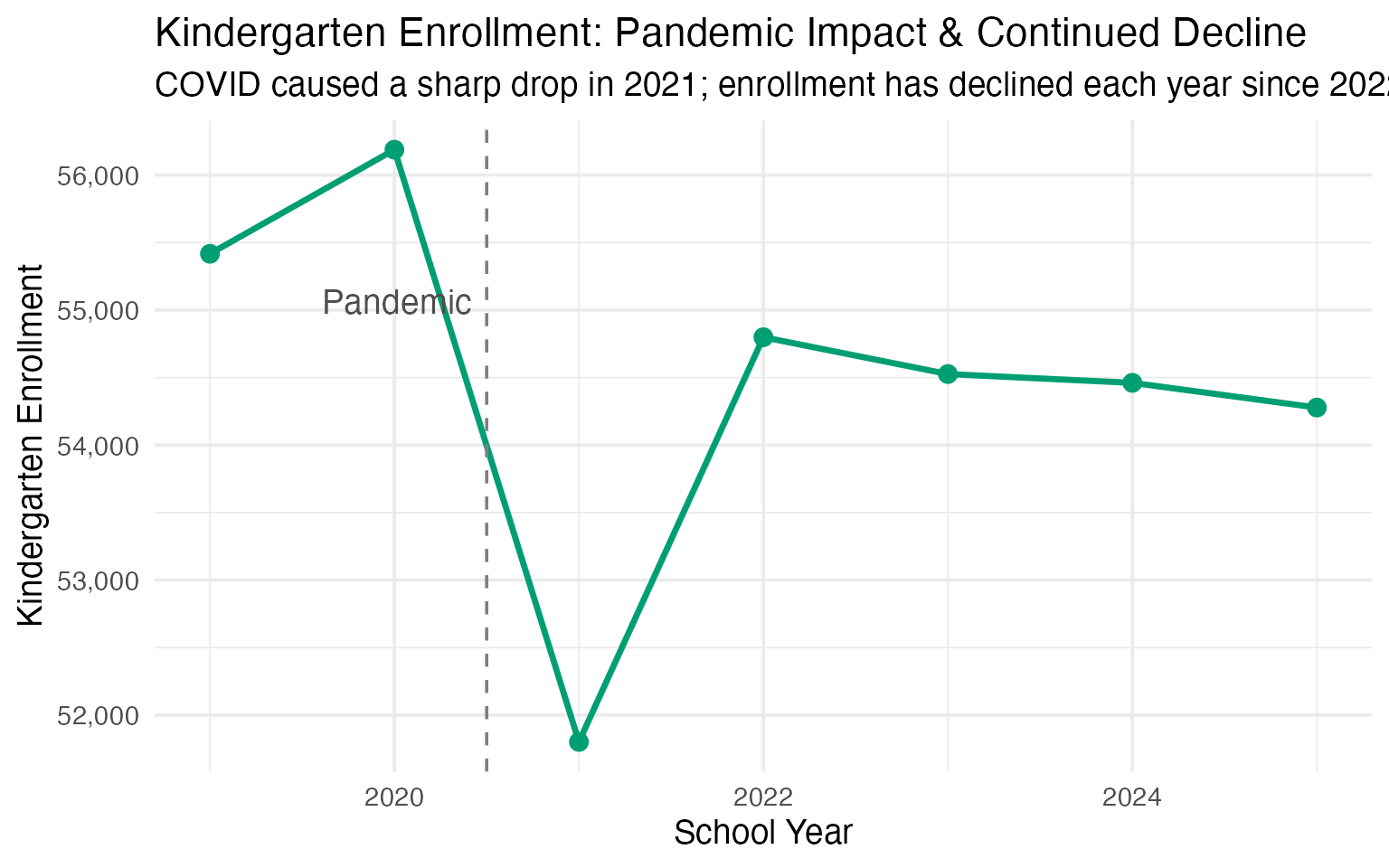
2. South Carolina’s racial composition is shifting fast
In just 8 years, the white share of enrollment has dropped from over 51% to under 48%, while Hispanic enrollment has surged from 9% to nearly 15%.
demo_enr <- fetch_enr_multi(c(2017, 2020, 2025), use_cache = TRUE)

demo_shift <- demo_enr |>
  filter(is_state, grade_level == "TOTAL",
         subgroup %in% c("white", "black", "hispanic", "multiracial")) |>
  select(end_year, subgroup, n_students) |>
  group_by(end_year) |>
  mutate(pct = round(n_students / sum(n_students, na.rm = TRUE) * 100, 1)) |>
  ungroup()
stopifnot(nrow(demo_shift) > 0)

demo_shift |>
  select(end_year, subgroup, n_students, pct) |>
  pivot_wider(names_from = end_year, values_from = c(n_students, pct))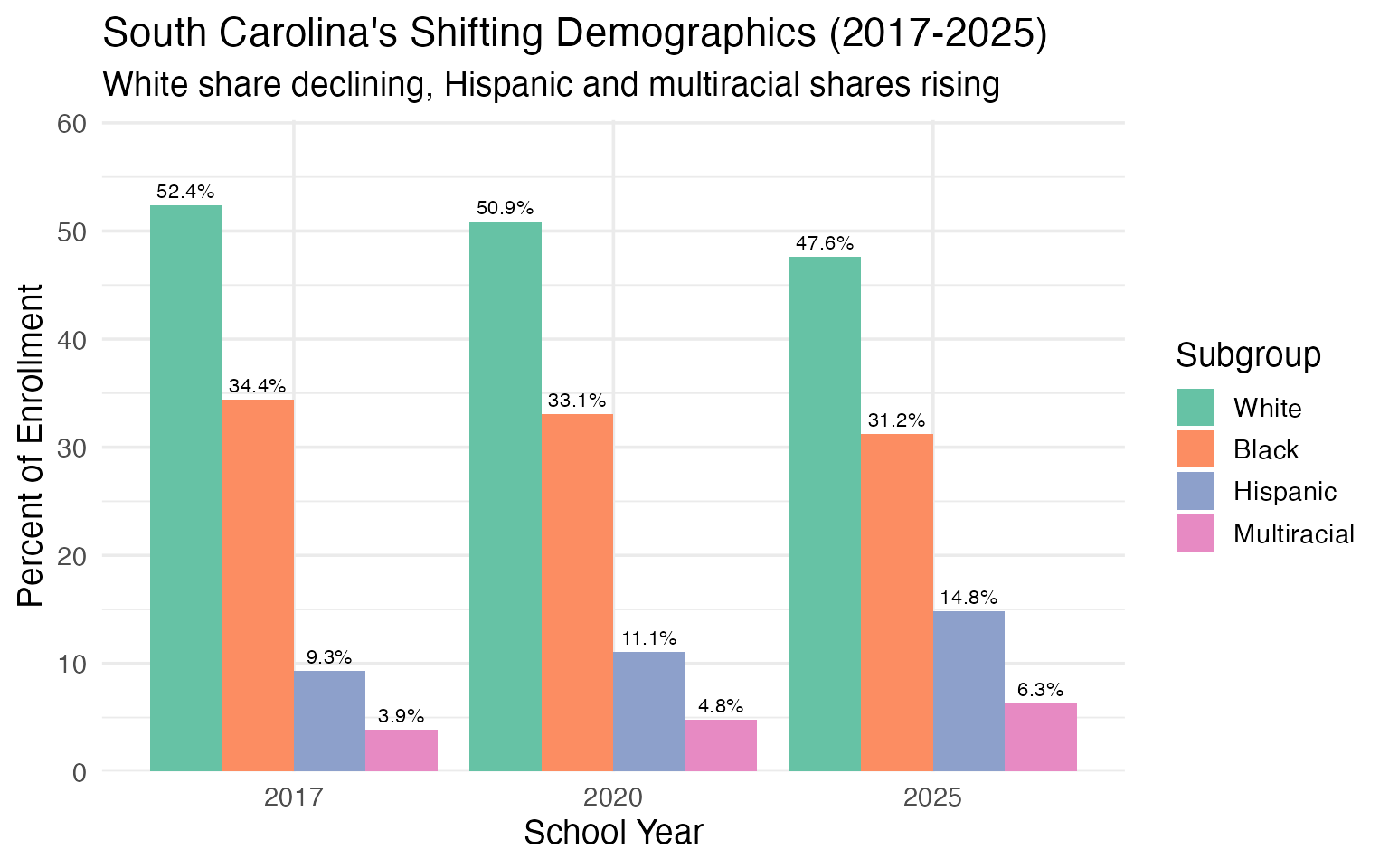
3. State-authorized charters are growing fast
The SC Public Charter School District (code 900) serves state-authorized charter schools and has grown to over 21,000 students.
charter_enr <- fetch_enr_multi(c(2015, 2020, 2025), use_cache = TRUE)

charter_trends <- charter_enr |>
  filter(
    grepl("Charter School District", district_name),
    is_district,
    subgroup == "total_enrollment",
    grade_level == "TOTAL"
  ) |>
  select(end_year, n_students)
stopifnot(nrow(charter_trends) > 0)

charter_trends
enr_2025 <- fetch_enr(2025, use_cache = TRUE)

# Charter as percent of state
charter_pct <- enr_2025 |>
  filter(is_state | grepl("Charter School District", district_name),
         subgroup == "total_enrollment", grade_level == "TOTAL") |>
  select(district_name, n_students) |>
  mutate(type = ifelse(is.na(district_name), "State Total", "Charter")) |>
  select(type, n_students)

charter_pct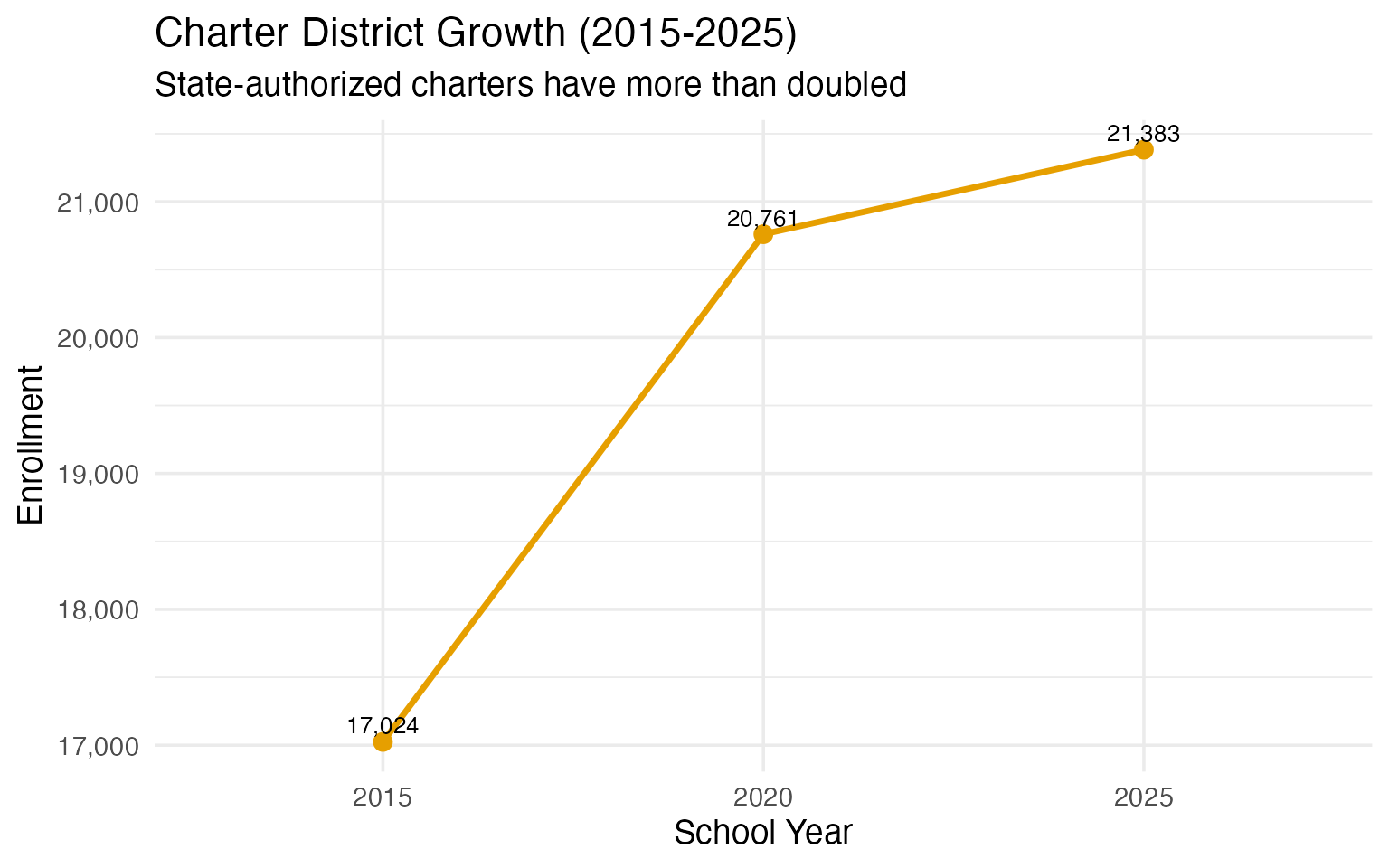
Data Taxonomy
| Category | Years | Function | Details |
|---|---|---|---|
| Enrollment | 2013-2025 |
fetch_enr() / fetch_enr_multi()
|
State, district, school. Race, gender, econ disadv |
| Assessments | — | — | Not yet available |
| Graduation | — | — | Not yet available |
| Directory | 2018-2025 | fetch_directory() |
School, district. Principal, superintendent, address, phone, website |
| Per-Pupil Spending | — | — | Not yet available |
| Accountability | — | — | Not yet available |
| Chronic Absence | — | — | Not yet available |
| EL Progress | — | — | Not yet available |
| Special Ed | — | — | Not yet available |
See the full data category taxonomy
Quick Start
R
# install.packages("devtools")
devtools::install_github("almartin82/scschooldata")
library(scschooldata)
library(dplyr)

# Get 2025 enrollment data (2024-25 school year)
enr <- fetch_enr(2025, use_cache = TRUE)

# Statewide total
enr |>
  filter(is_state, subgroup == "total_enrollment", grade_level == "TOTAL") |>
  pull(n_students)

# Top 10 districts
enr |>
  filter(is_district, subgroup == "total_enrollment", grade_level == "TOTAL") |>
  arrange(desc(n_students)) |>
  select(district_name, n_students) |>
  head(10)

# Get multiple years
enr_multi <- fetch_enr_multi(2020:2025, use_cache = TRUE)
Python
import pyscschooldata as sc

# Get 2025 enrollment data (2024-25 school year)
df = sc.fetch_enr(2025)

# Statewide total
state_total = df[(df['is_state'] == True) &
                 (df['subgroup'] == 'total_enrollment') &
                 (df['grade_level'] == 'TOTAL')]['n_students'].values[0]
print(f"Total enrollment: {state_total:,}")

# Top 10 districts
districts = df[(df['is_district'] == True) &
               (df['subgroup'] == 'total_enrollment') &
               (df['grade_level'] == 'TOTAL')]
print(districts.nlargest(10, 'n_students')[['district_name', 'n_students']])

# Get multiple years
df_multi = sc.fetch_enr_multi([2020, 2021, 2022, 2023, 2024, 2025])
Explore More
Full analysis with 15 stories: - Enrollment trends – 15 stories - Function reference
Data Notes
Source
Data is sourced directly from the South Carolina Department of Education Active Student Headcounts.
Available Years
- 2013-2025 (13 years of data)
- Data reflects the 45-day count (early fall enrollment snapshot)
Suppression Rules
South Carolina does not suppress small cell counts in the Active Student Headcounts data. All counts are reported as-is from the state.
Deeper Dive
4. South Carolina is growing
Unlike many states facing enrollment decline, South Carolina has added approximately 40,000 students since 2015. The Palmetto State’s population growth is reflected in its schools.
enr <- fetch_enr_multi(c(2015, 2017, 2019, 2021, 2023, 2025), use_cache = TRUE)

state_totals <- enr |>
  filter(is_state, subgroup == "total_enrollment", grade_level == "TOTAL") |>
  select(end_year, n_students) |>
  mutate(
    change = n_students - lag(n_students),
    pct_change = round(change / lag(n_students) * 100, 2)
  )
stopifnot(nrow(state_totals) > 0)

state_totals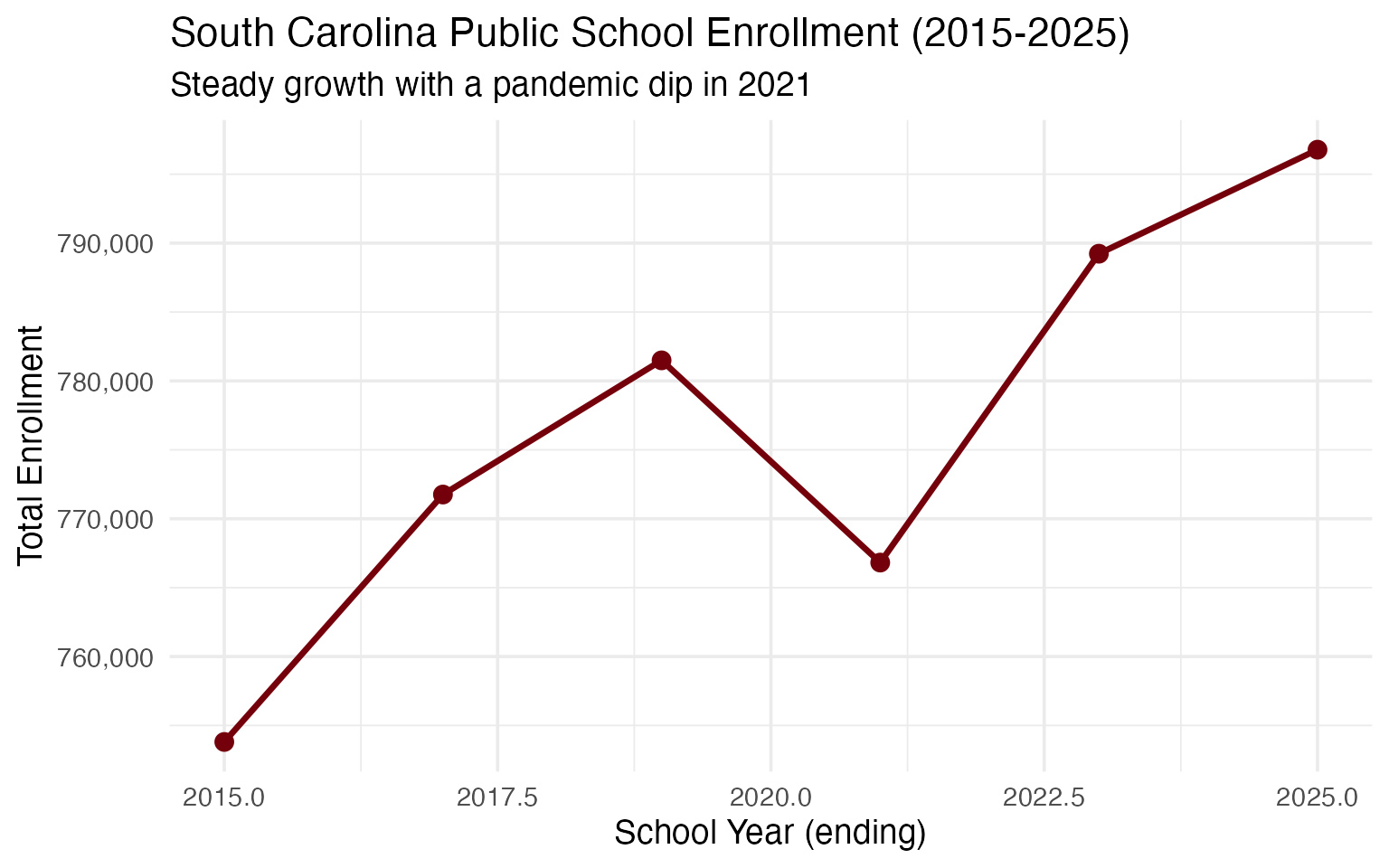
5. Greenville County is the giant
Greenville County Schools enrolls nearly 77,000 students, making it the largest district in the state and one of the largest in the Southeast.
enr_2025 <- fetch_enr(2025, use_cache = TRUE)

top_districts <- enr_2025 |>
  filter(is_district, subgroup == "total_enrollment", grade_level == "TOTAL") |>
  arrange(desc(n_students)) |>
  head(10) |>
  select(district_name, n_students)
stopifnot(nrow(top_districts) > 0)

top_districts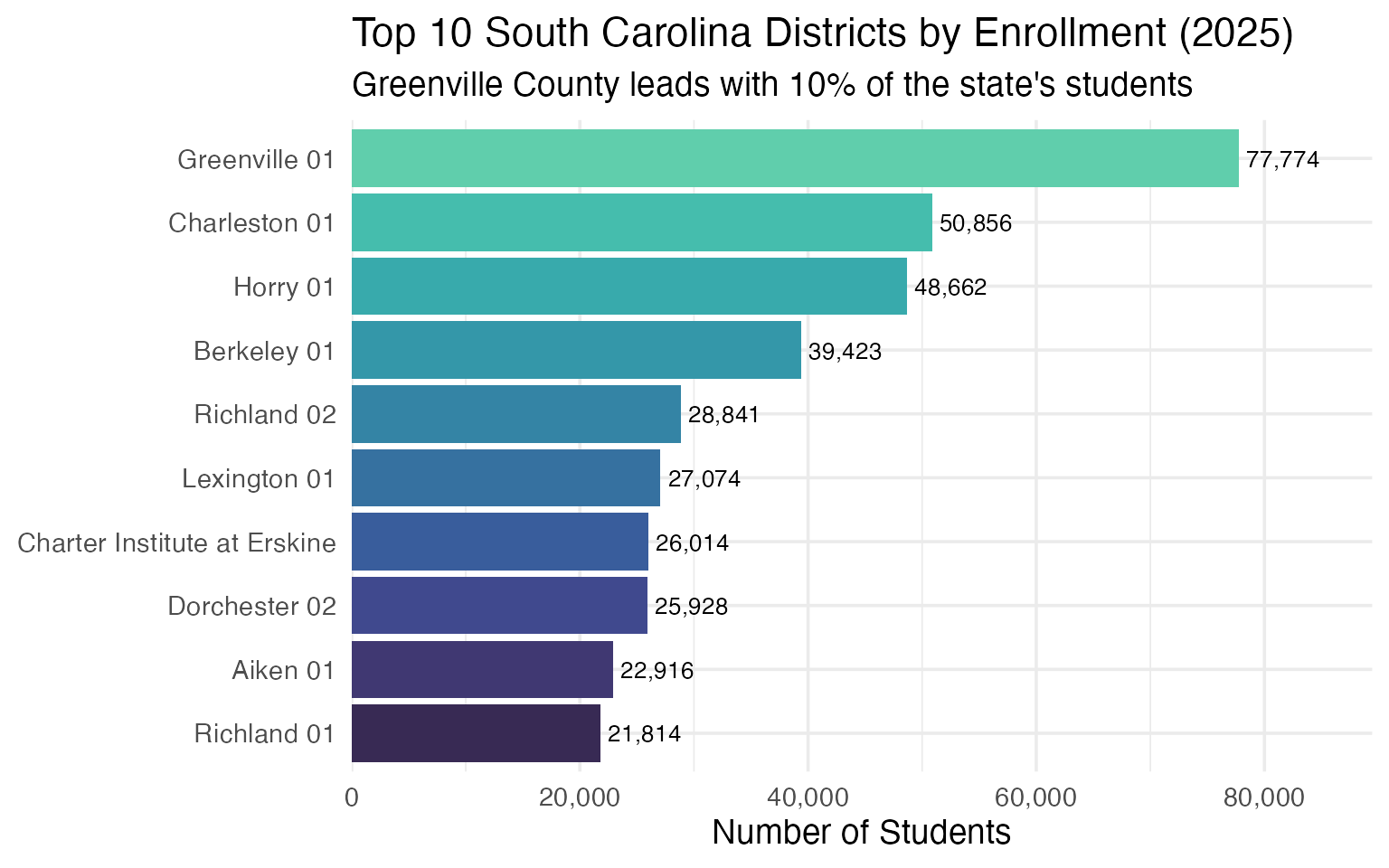
6. Hispanic enrollment is surging
Hispanic student enrollment has risen steadily, growing from about 10% in 2019 to over 14% of total enrollment in 2025.
demographics <- enr_2025 |>
  filter(is_state, grade_level == "TOTAL",
         subgroup %in% c("white", "black", "hispanic", "asian",
                         "native_american", "pacific_islander", "multiracial")) |>
  mutate(pct = round(n_students / sum(n_students, na.rm = TRUE) * 100, 1)) |>
  select(subgroup, n_students, pct) |>
  arrange(desc(n_students))
stopifnot(nrow(demographics) > 0)

demographics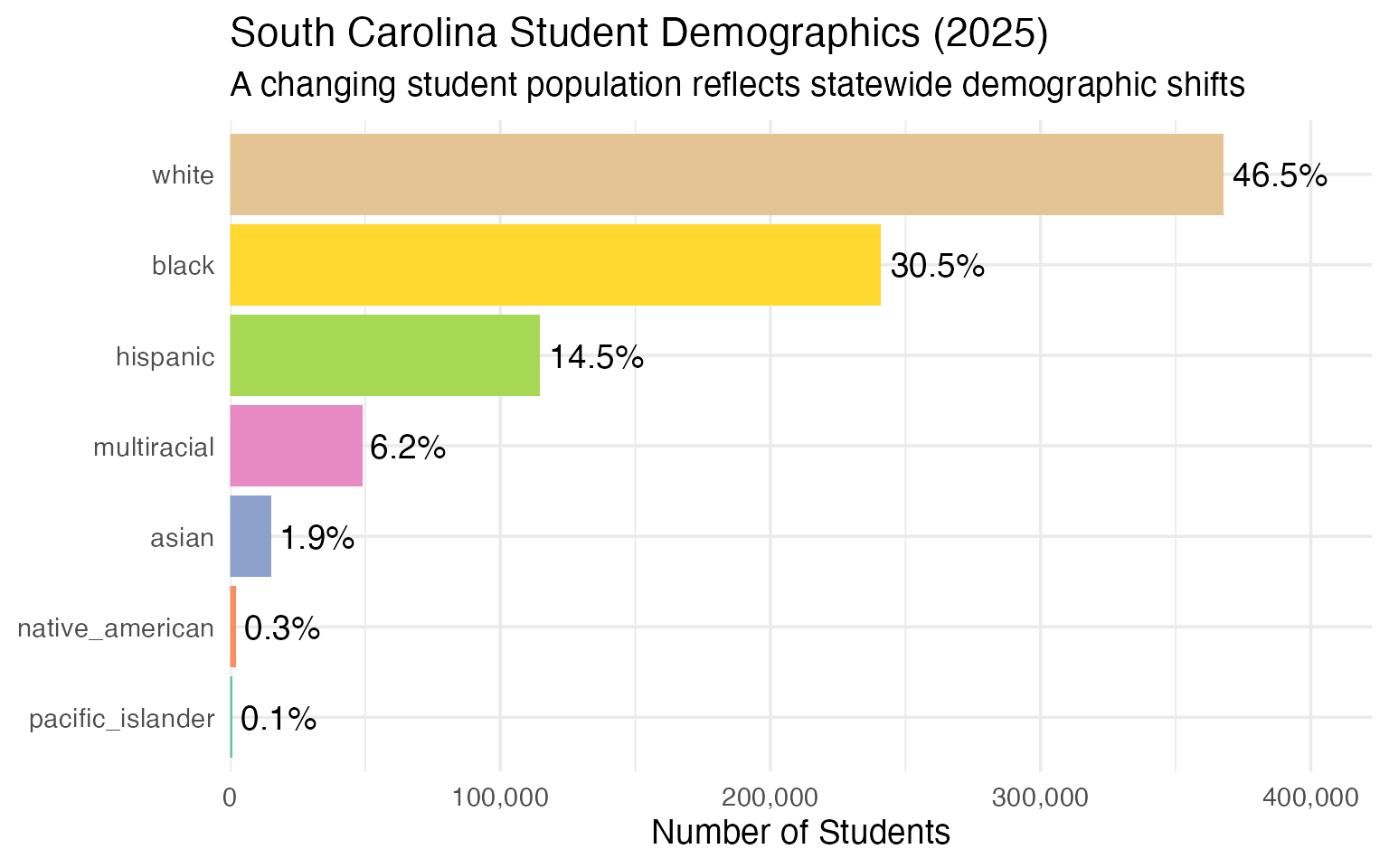
7. The I-85 Corridor is booming
Districts along the I-85 corridor from Greenville through Spartanburg are among the fastest-growing in the state, fueled by economic development and migration from other states.
i85_districts <- enr_2025 |>
  filter(
    grepl("Greenville|Spartanburg|Anderson", district_name),
    is_district,
    subgroup == "total_enrollment",
    grade_level == "TOTAL"
  ) |>
  arrange(desc(n_students)) |>
  select(district_name, n_students) |>
  head(8)
stopifnot(nrow(i85_districts) > 0)

i85_districts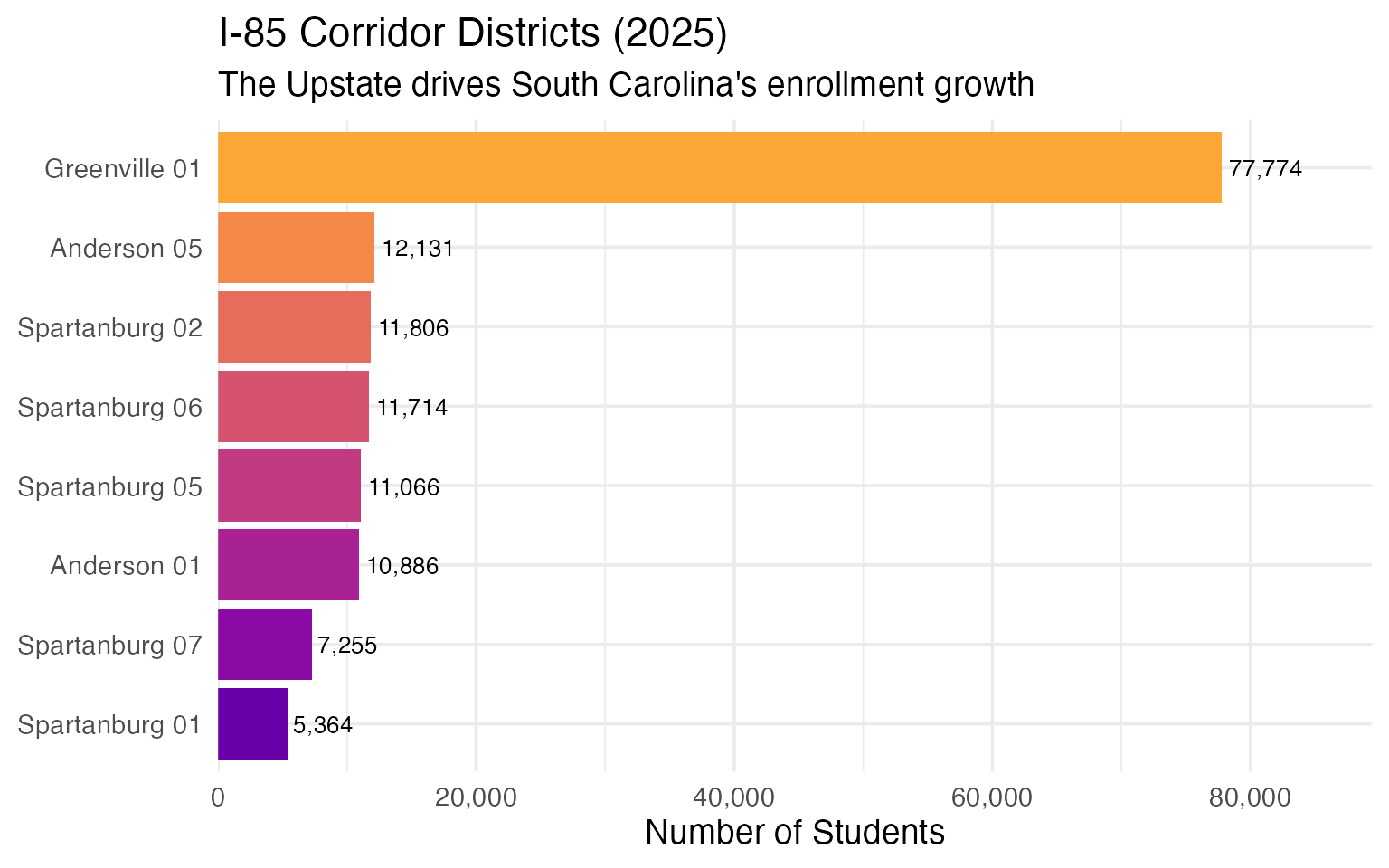
8. The Lowcountry is expanding
Charleston, Berkeley, and Dorchester counties form South Carolina’s tri-county Lowcountry region, and all three have seen substantial enrollment growth.
lowcountry_enr <- fetch_enr_multi(c(2015, 2020, 2025), use_cache = TRUE)

lowcountry <- lowcountry_enr |>
  filter(
    grepl("Charleston|Berkeley|Dorchester", district_name),
    is_district,
    subgroup == "total_enrollment",
    grade_level == "TOTAL"
  ) |>
  select(end_year, district_name, n_students) |>
  pivot_wider(names_from = end_year, values_from = n_students) |>
  mutate(
    growth = `2025` - `2015`,
    pct_growth = round(growth / `2015` * 100, 1)
  ) |>
  arrange(desc(growth))
stopifnot(nrow(lowcountry) > 0)

lowcountry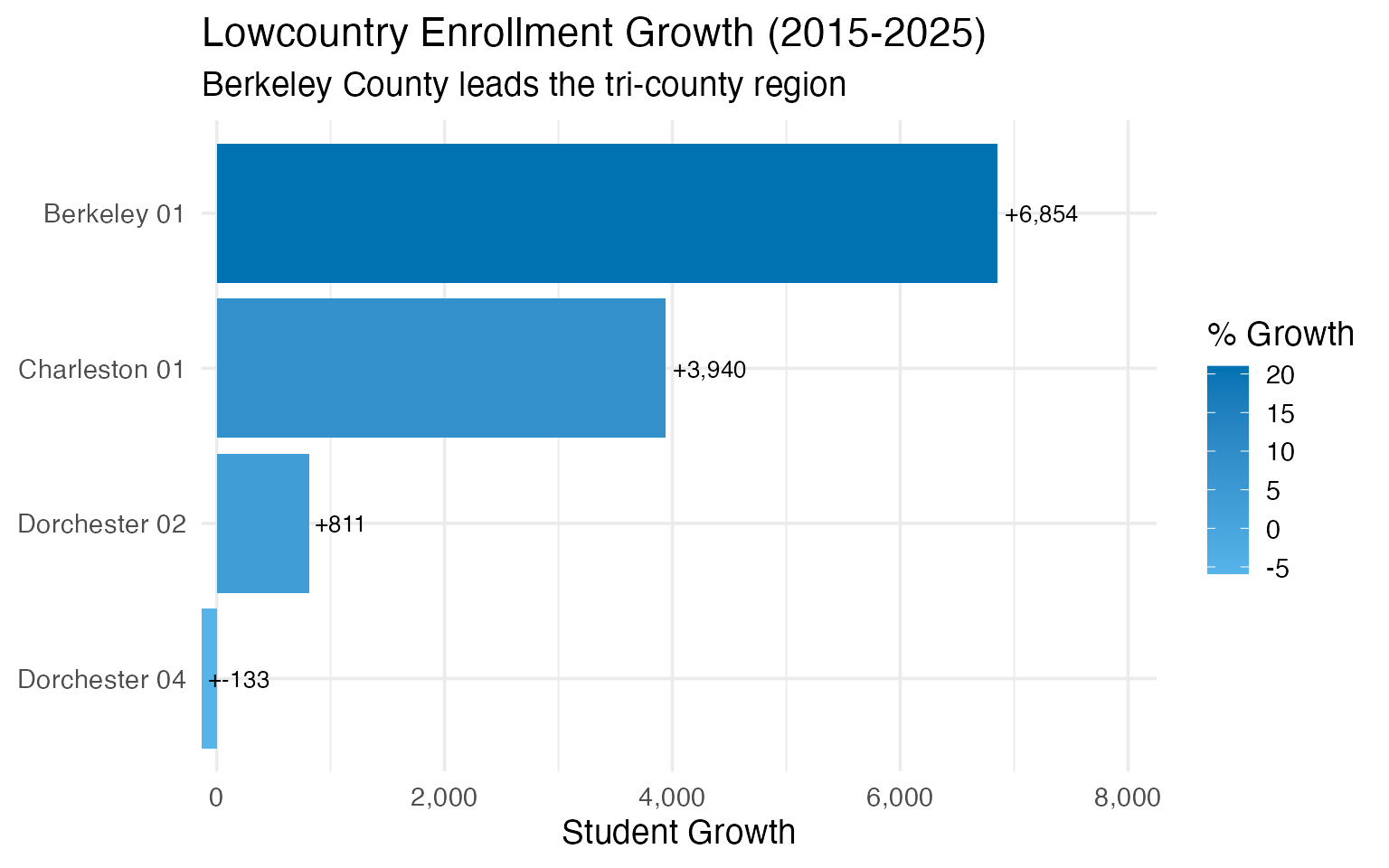
9. Rural Pee Dee districts are declining
While much of South Carolina grows, rural districts in the Pee Dee region face persistent enrollment decline.
pee_dee_enr <- fetch_enr_multi(c(2015, 2025), use_cache = TRUE)

pee_dee <- pee_dee_enr |>
  filter(
    grepl("Marion|Dillon|Marlboro|Florence", district_name),
    is_district,
    subgroup == "total_enrollment",
    grade_level == "TOTAL"
  ) |>
  select(end_year, district_name, n_students) |>
  pivot_wider(names_from = end_year, values_from = n_students) |>
  mutate(
    change = `2025` - `2015`,
    pct_change = round(change / `2015` * 100, 1)
  ) |>
  filter(!is.na(`2015`), !is.na(`2025`)) |>
  arrange(pct_change) |>
  head(8)
stopifnot(nrow(pee_dee) > 0)

pee_dee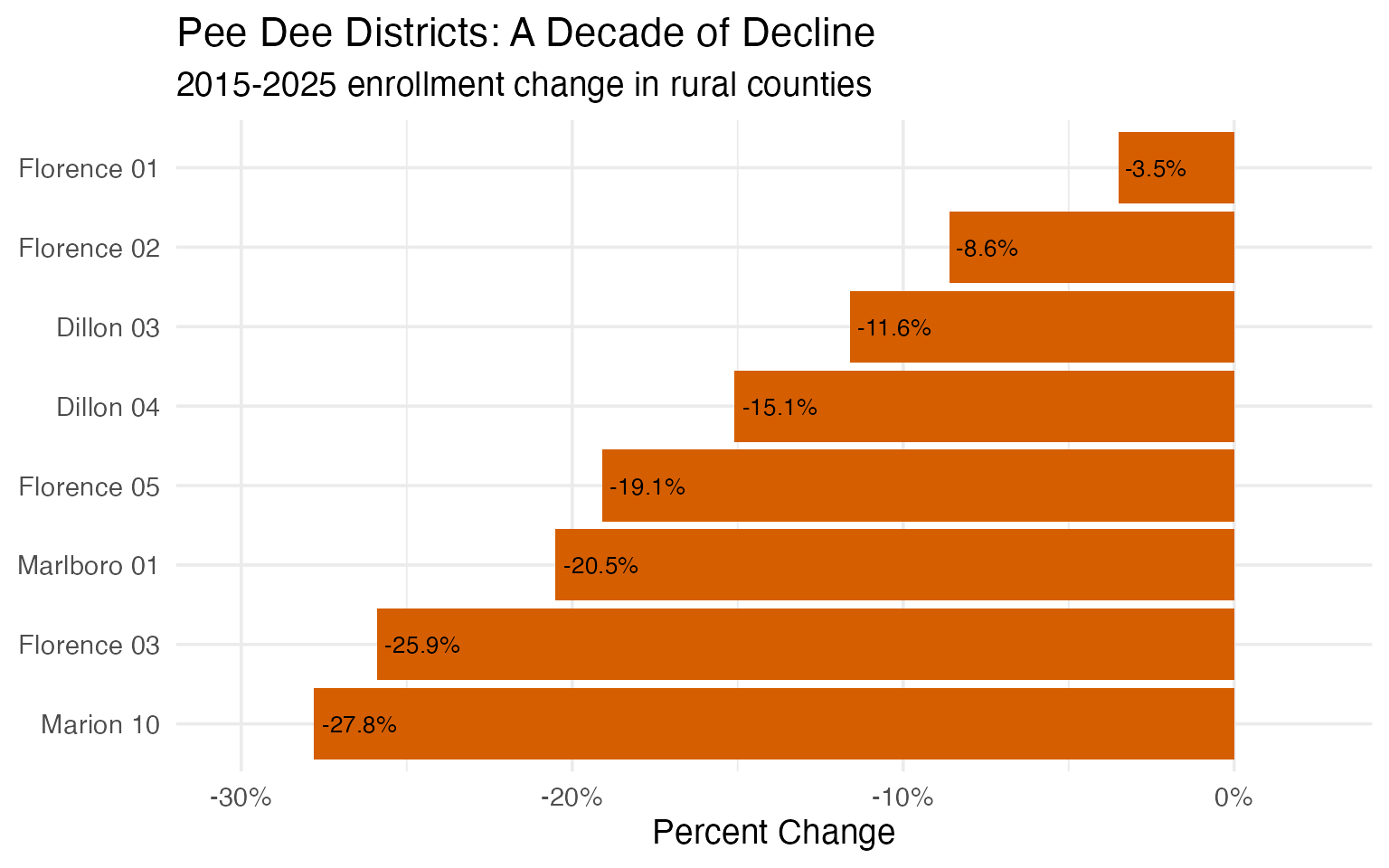
10. District size varies dramatically
South Carolina’s 80 districts range from tiny rural systems to massive county-wide operations serving tens of thousands.
district_sizes <- enr_2025 |>
  filter(is_district, subgroup == "total_enrollment", grade_level == "TOTAL") |>
  mutate(size_bucket = case_when(
    n_students < 5000 ~ "Small (<5K)",
    n_students < 15000 ~ "Medium (5K-15K)",
    n_students < 30000 ~ "Large (15K-30K)",
    TRUE ~ "Very Large (30K+)"
  )) |>
  count(size_bucket) |>
  mutate(size_bucket = factor(size_bucket,
                              levels = c("Small (<5K)", "Medium (5K-15K)",
                                         "Large (15K-30K)", "Very Large (30K+)")))
stopifnot(nrow(district_sizes) > 0)

district_sizes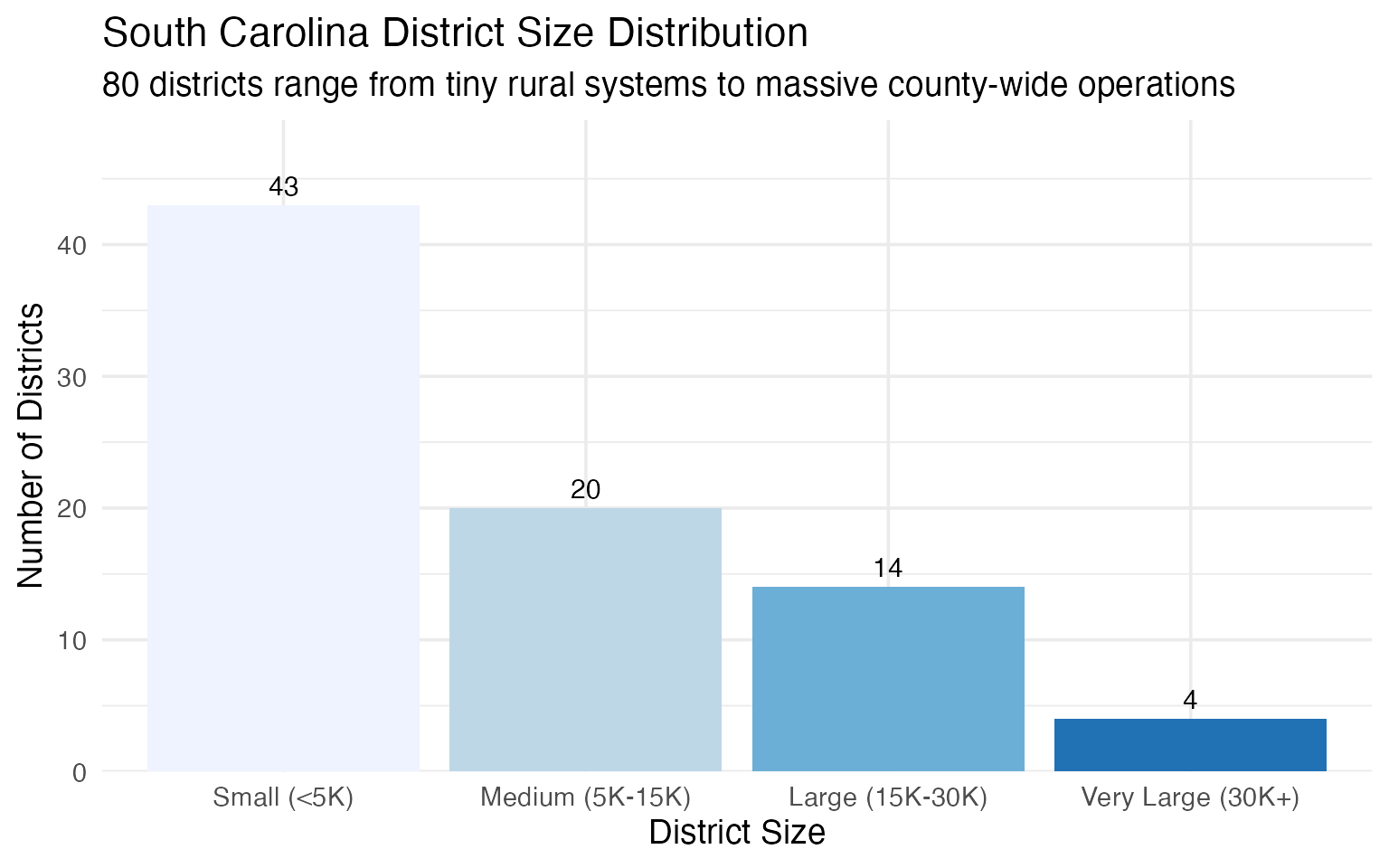
11. Richland vs Lexington: Columbia’s Suburban Divide
The Columbia metro area is split between Richland and Lexington counties, with very different enrollment trajectories. Lexington County districts have grown substantially while Richland districts have been more stable.
columbia_enr <- fetch_enr_multi(c(2015, 2020, 2025), use_cache = TRUE)

columbia_districts <- columbia_enr |>
  filter(
    grepl("Richland|Lexington", district_name),
    is_district,
    subgroup == "total_enrollment",
    grade_level == "TOTAL"
  ) |>
  select(end_year, district_name, n_students) |>
  pivot_wider(names_from = end_year, values_from = n_students) |>
  mutate(
    growth = `2025` - `2015`,
    pct_growth = round(growth / `2015` * 100, 1),
    county = ifelse(grepl("Richland", district_name), "Richland", "Lexington")
  ) |>
  filter(!is.na(`2015`), !is.na(`2025`)) |>
  arrange(desc(growth))
stopifnot(nrow(columbia_districts) > 0)

columbia_districts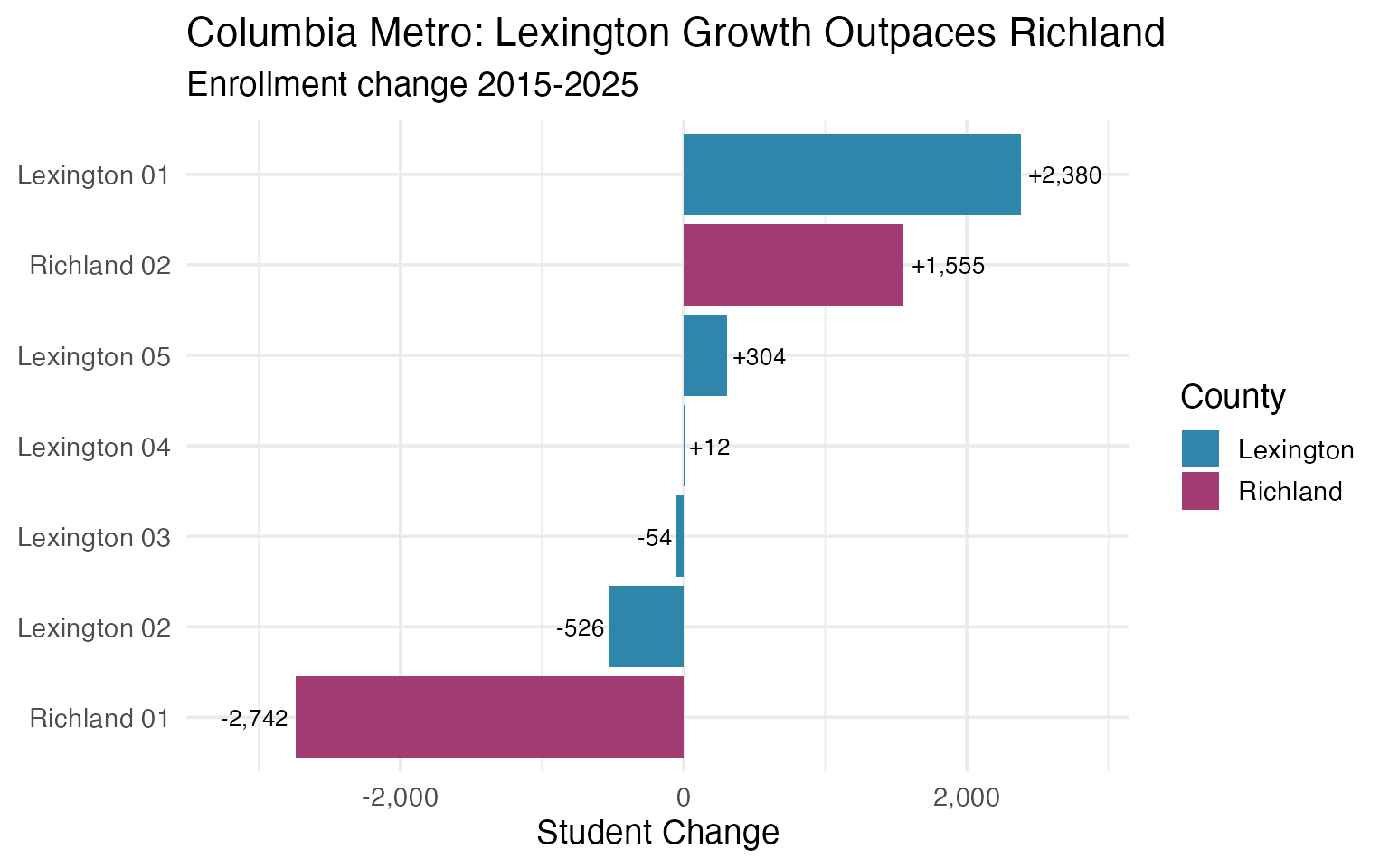
12. Boys slightly outnumber girls statewide
South Carolina enrolls slightly more male than female students overall, a pattern consistent across most large districts.
gender_data <- enr_2025 |>
  filter(
    is_district,
    subgroup %in% c("male", "female"),
    grade_level == "TOTAL"
  ) |>
  select(district_name, subgroup, n_students) |>
  pivot_wider(names_from = subgroup, values_from = n_students) |>
  filter(!is.na(male), !is.na(female)) |>
  mutate(
    total = male + female,
    pct_male = round(male / total * 100, 1)
  ) |>
  arrange(desc(total)) |>
  head(15)
stopifnot(nrow(gender_data) > 0)

gender_data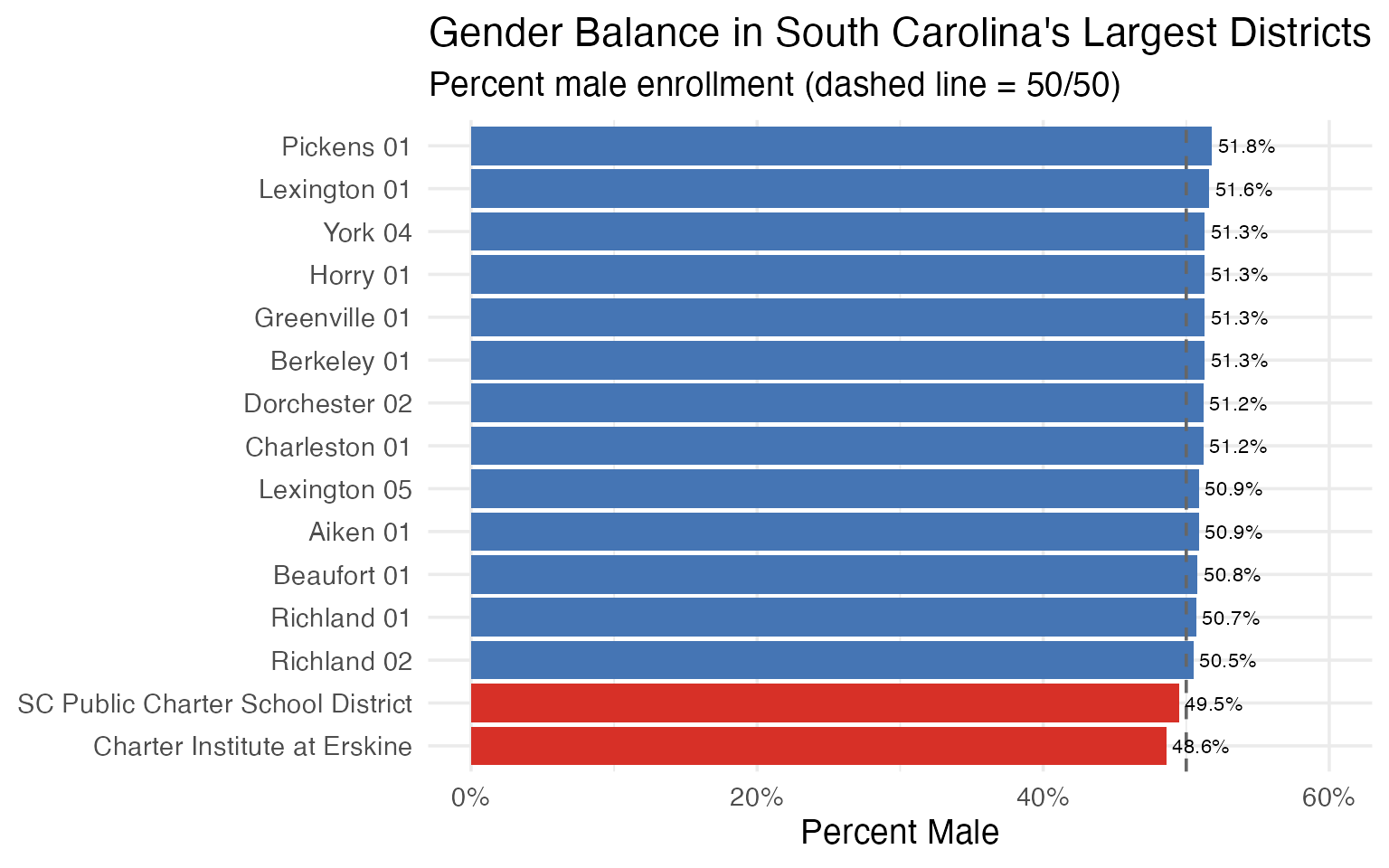
13. High School Enrollment: The 9th Grade Bulge
High schools show a distinctive enrollment pattern: 9th grade is consistently the largest, with enrollment declining through 12th grade. This reflects retention, transfers, and dropouts.
hs_grades <- enr_2025 |>
  filter(
    is_state,
    subgroup == "total_enrollment",
    grade_level %in% c("09", "10", "11", "12")
  ) |>
  select(grade_level, n_students) |>
  mutate(
    grade_label = case_when(
      grade_level == "09" ~ "9th Grade",
      grade_level == "10" ~ "10th Grade",
      grade_level == "11" ~ "11th Grade",
      grade_level == "12" ~ "12th Grade"
    ),
    grade_label = factor(grade_label, levels = c("9th Grade", "10th Grade", "11th Grade", "12th Grade")),
    pct_of_9th = round(n_students / first(n_students) * 100, 1)
  )
stopifnot(nrow(hs_grades) > 0)

hs_grades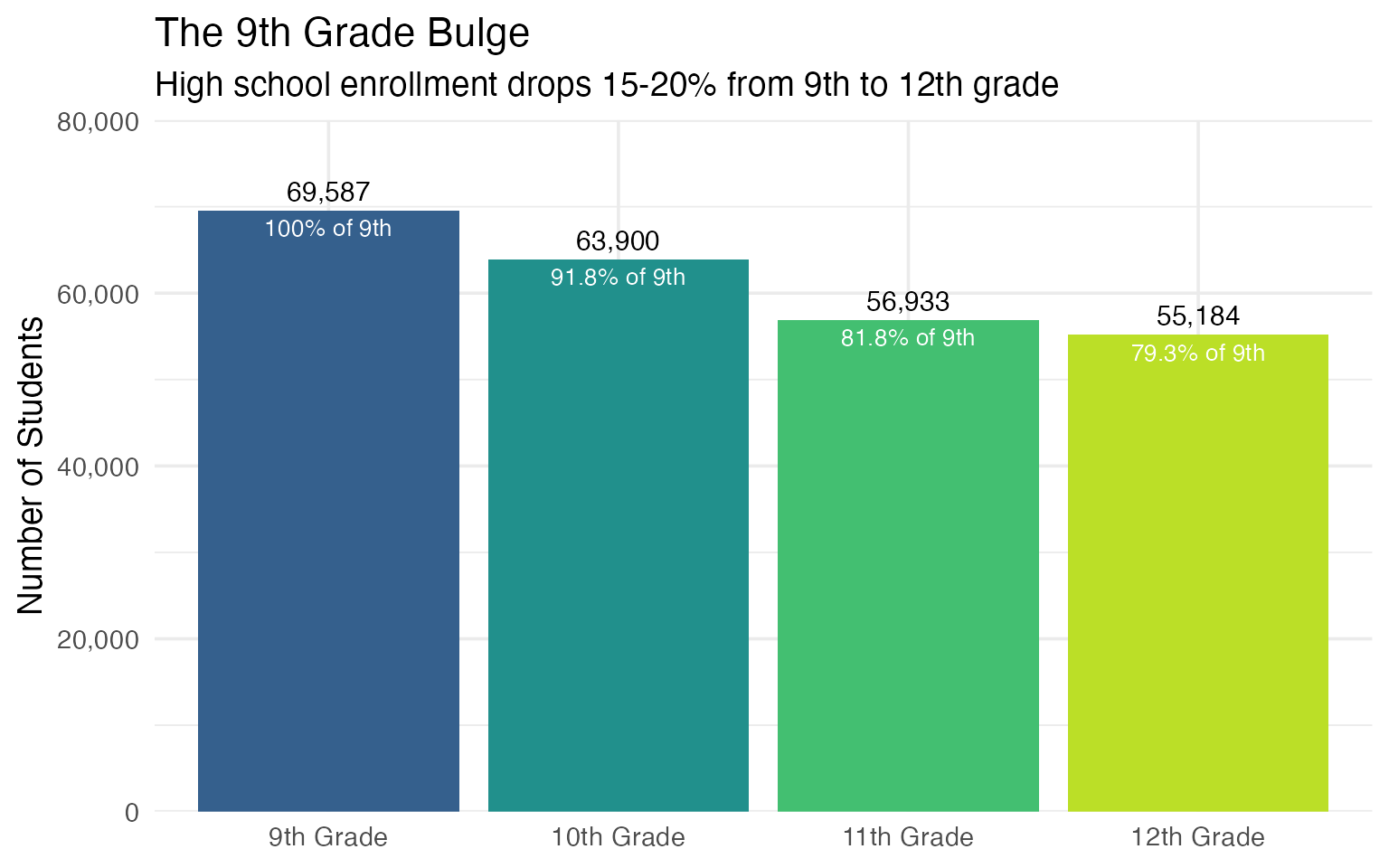
14. South Carolina’s Smallest Districts
Not all South Carolina districts are massive county systems. Several rural districts serve fewer than 2,000 students.
smallest <- enr_2025 |>
  filter(
    is_district,
    subgroup == "total_enrollment",
    grade_level == "TOTAL",
    !grepl("Charter", district_name)
  ) |>
  arrange(n_students) |>
  select(district_name, n_students) |>
  head(10)
stopifnot(nrow(smallest) > 0)

smallest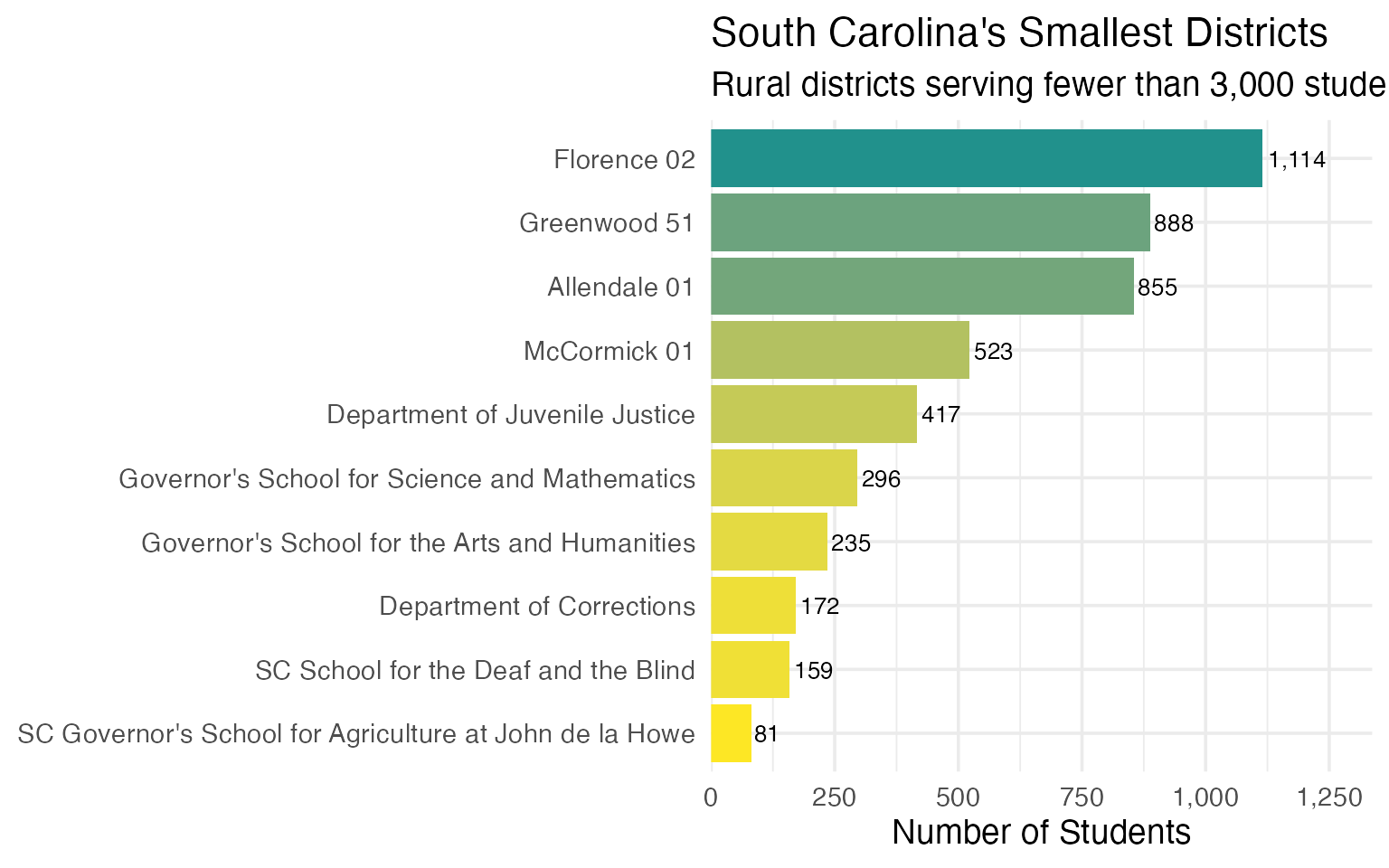
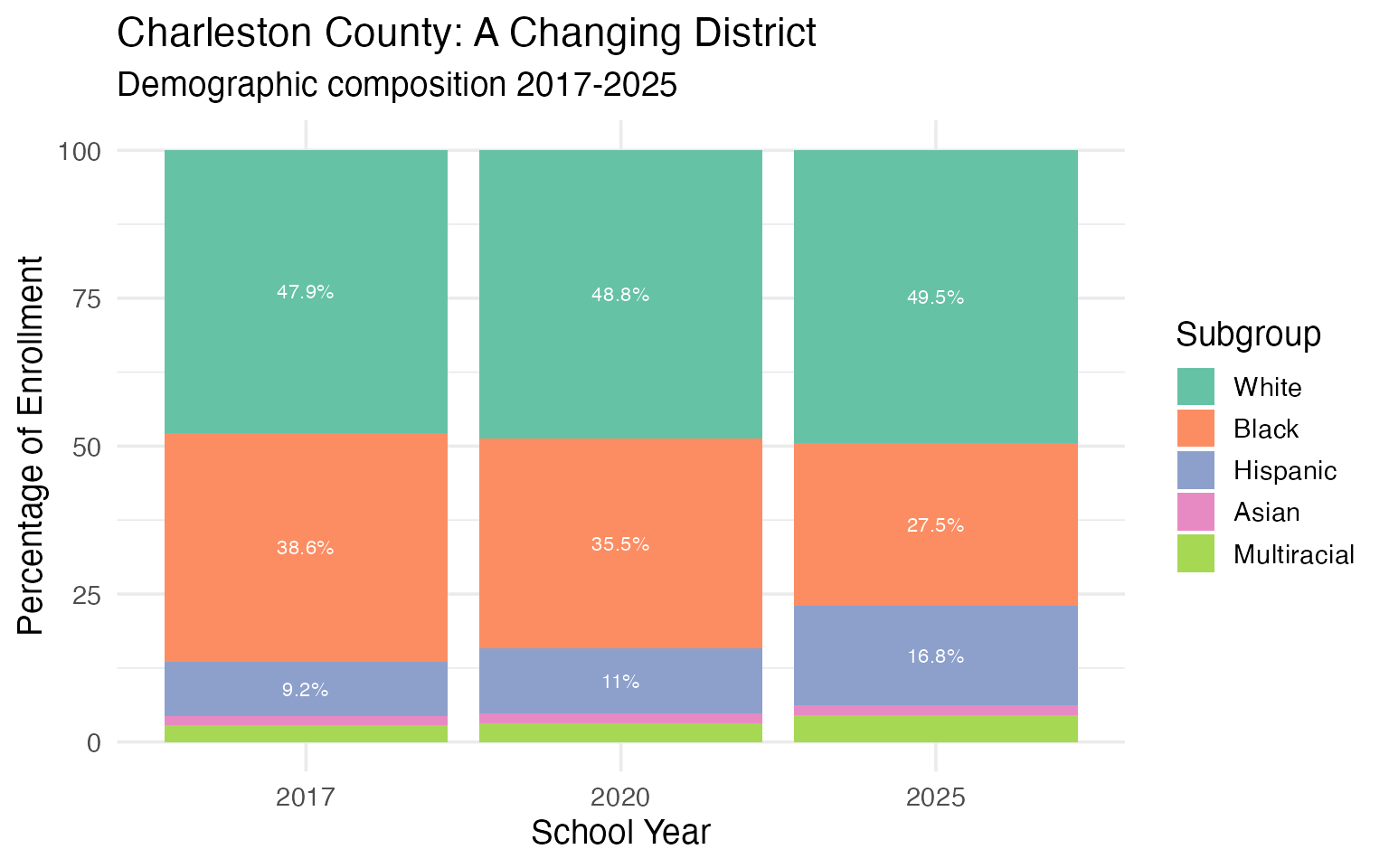
15. Charleston’s Decade of Transformation
Charleston 01 (Charleston County) has undergone significant demographic change in recent years, reflecting the city’s rapid growth and gentrification.
charleston_demo <- fetch_enr_multi(c(2017, 2020, 2025), use_cache = TRUE)

charleston_demo_trends <- charleston_demo |>
  filter(
    grepl("Charleston", district_name),
    is_district,
    grade_level == "TOTAL",
    subgroup %in% c("white", "black", "hispanic", "asian", "multiracial")
  ) |>
  select(end_year, subgroup, n_students) |>
  group_by(end_year) |>
  mutate(pct = round(n_students / sum(n_students, na.rm = TRUE) * 100, 1)) |>
  ungroup()
stopifnot(nrow(charleston_demo_trends) > 0)

charleston_demo_trends |>
  pivot_wider(names_from = end_year, values_from = c(n_students, pct))