Fetch and analyze Florida school enrollment, assessment, and graduation data from the Florida Department of Education (FLDOE) in R or Python. Nearly 3 million students across 67 county districts in the Sunshine State – 18 years of enrollment (2008-2025), assessments (2019-2025), and graduation rates (2016-2024).
Part of the njschooldata family.
Full documentation – all 30 stories with interactive charts, getting-started guide, and complete function reference.
Highlights
library(flschooldata)
library(dplyr)
library(tidyr)
library(ggplot2)

theme_set(theme_minimal(base_size = 14))

enr <- fetch_enr_multi(2015:2024, use_cache = TRUE)
enr_2024 <- fetch_enr(2024, use_cache = TRUE)
1. Hispanic enrollment surpassed White for the first time
A demographic milestone: Hispanic student enrollment has overtaken White enrollment in Florida, reflecting broader population shifts.
crossover <- enr |>
  filter(is_state, grade_level == "TOTAL",
         subgroup %in% c("hispanic", "white")) |>
  select(end_year, subgroup, n_students) |>
  pivot_wider(names_from = subgroup, values_from = n_students)

crossover
stopifnot(nrow(crossover) > 0)
#>    end_year   white hispanic
#> 1      2015 1108227   846425
#> 2      2016 1101823   879982
#> 3      2017 1089439   912300
#> 4      2018 1077811   937352
#> 5      2019 1063838   963338
#> 6      2020 1054580   986005
#> 7      2021 1016772   974588
#> 8      2022 1021630  1003659
#> 9      2023 1014065  1043390
#> 10     2024  988822  1066935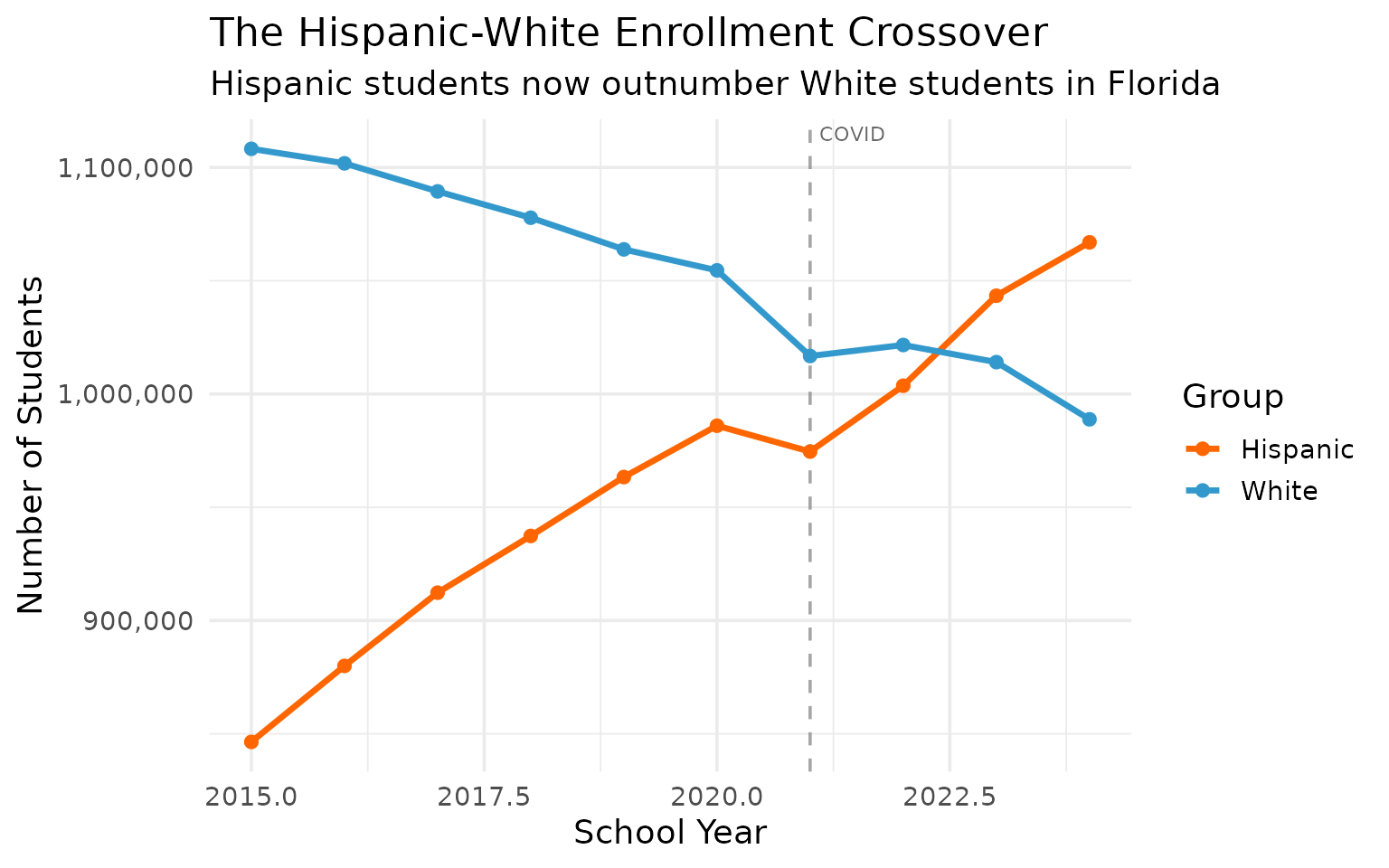
2. Just over half of Florida third graders read on grade level
In 2024, 55% of Florida 3rd graders scored at Level 3 or above on the FAST ELA Reading assessment.
assess_2024 <- fetch_assessment(2024, "ela", grade = 3, level = "district",
                                 tidy = FALSE, use_cache = TRUE)

state_g3 <- assess_2024 |>
  filter(is_state) |>
  select(end_year, subject, grade, n_tested, pct_proficient,
         pct_level_1, pct_level_2, pct_level_3, pct_level_4, pct_level_5)

state_g3
stopifnot(nrow(state_g3) > 0)
#>   end_year subject grade n_tested pct_proficient pct_level_1 pct_level_2
#> 1     2024     ELA    03   216473             55          22          22
#>   pct_level_3 pct_level_4 pct_level_5
#> 1          23          19          13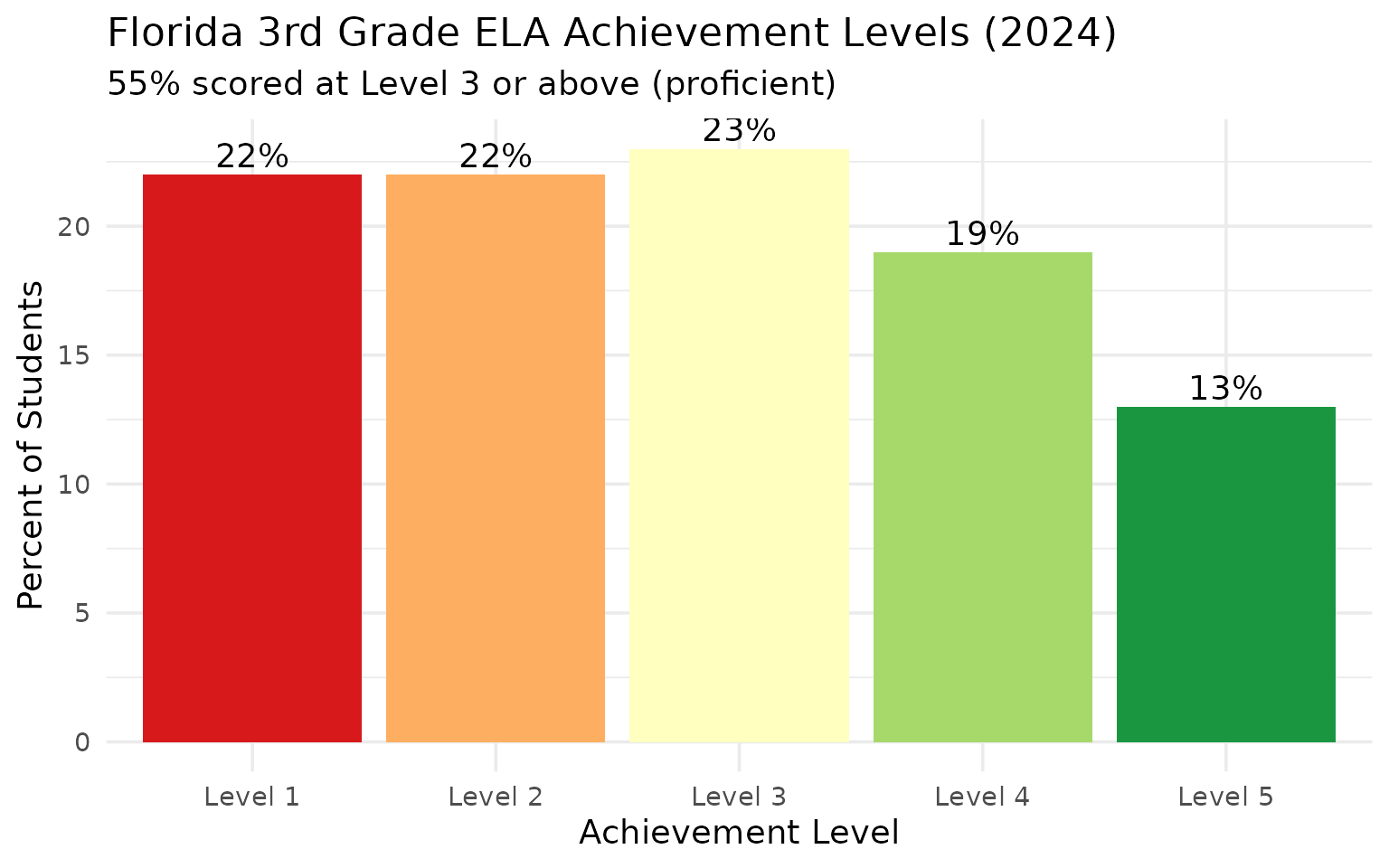
3. Multiracial students are the fastest-growing demographic
While Hispanic students are the largest group, multiracial student enrollment has grown at the highest rate percentage-wise since 2015 (34.9% growth, compared to 26.1% for Hispanic students and 15.3% for Asian students).
demo_trend <- enr |>
  filter(is_state, grade_level == "TOTAL",
         subgroup %in% c("hispanic", "white", "black", "asian", "multiracial")) |>
  select(end_year, subgroup, n_students) |>
  group_by(subgroup) |>
  mutate(pct_change = round((n_students / first(n_students) - 1) * 100, 1)) |>
  ungroup()

demo_2024 <- demo_trend |>
  filter(end_year == 2024) |>
  arrange(desc(pct_change))
demo_2024
stopifnot(nrow(demo_2024) > 0)
#>   end_year    subgroup n_students pct_change
#> 1     2024 multiracial     119907       34.9
#> 2     2024    hispanic    1066935       26.1
#> 3     2024       asian      81688       15.3
#> 4     2024       black     599867       -4.2
#> 5     2024       white     988822      -10.8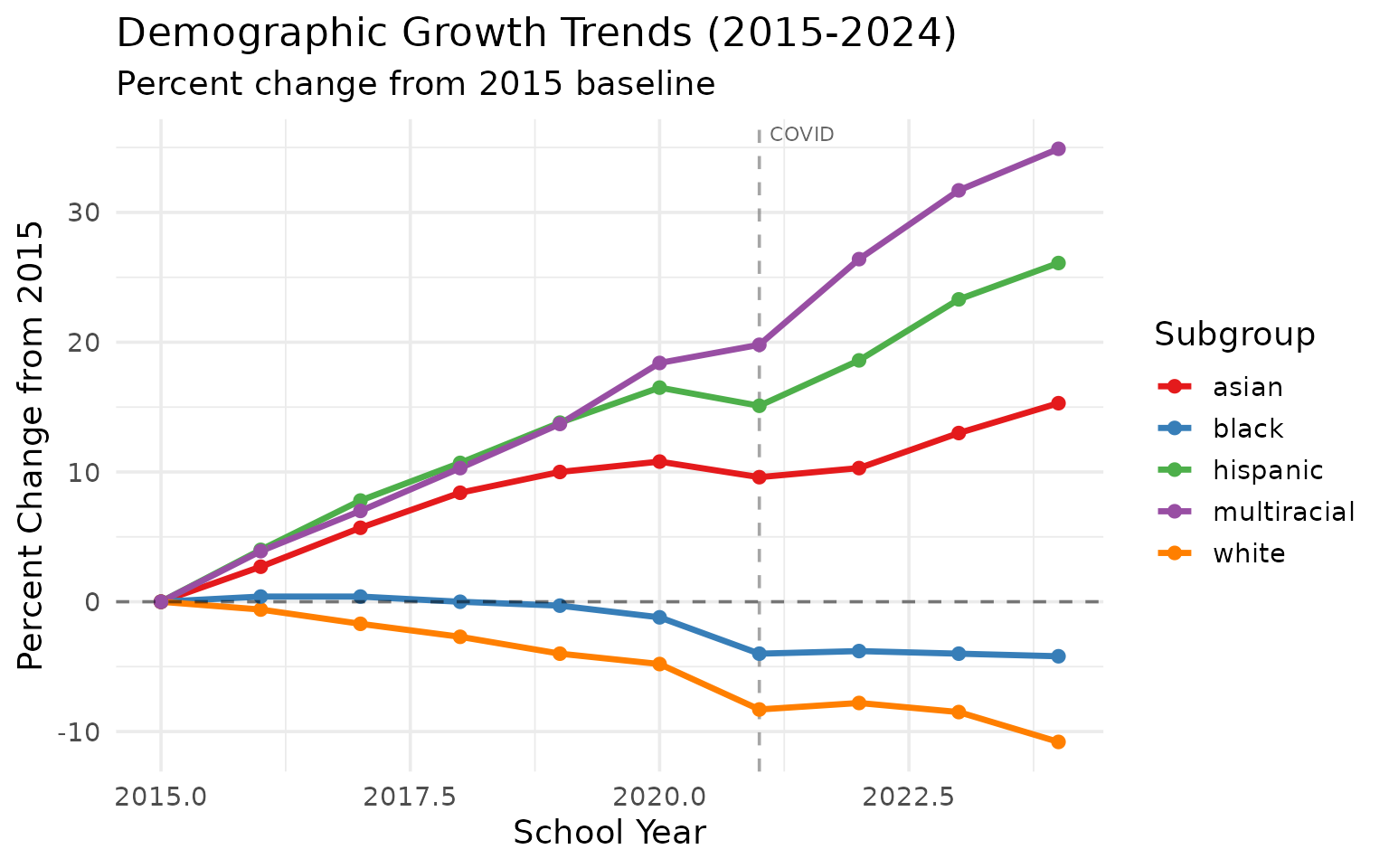
Data Taxonomy
| Category | Years | Function | Details |
|---|---|---|---|
| Enrollment | 2008-2025 |
fetch_enr() / fetch_enr_multi()
|
State, district, school. Race, gender |
| Assessments | 2019, 2022-2025 |
fetch_assessment() / fetch_assessment_multi()
|
ELA grades 3-10, Math grades 3-8. District, school |
| Graduation | 2016-2024 | fetch_graduation() |
State, district, school. 4-year cohort rates |
| Directory | Current | fetch_directory() |
All schools. Principal, address, phone, charter status, geo-coordinates |
| Per-Pupil Spending | – | – | Not yet available |
| Accountability | – | – | Not yet available |
| Chronic Absence | – | – | Not yet available |
| EL Progress | – | – | Not yet available |
| Special Ed | – | – | Not yet available |
See the full data category taxonomy for what each category covers.
Quick Start
R
# install.packages("remotes")
remotes::install_github("almartin82/flschooldata")

library(flschooldata)
library(dplyr)

# === Enrollment Data ===

# Fetch one year
enr_2025 <- fetch_enr(2025)

# Fetch multiple years
enr_multi <- fetch_enr_multi(2020:2025)

# State totals
enr_2025 %>%
  filter(is_state, subgroup == "total_enrollment", grade_level == "TOTAL")

# District breakdown
enr_2025 %>%
  filter(is_district, subgroup == "total_enrollment", grade_level == "TOTAL") %>%
  arrange(desc(n_students))

# Miami-Dade County (district 13)
enr_2025 %>%
  filter(district_id == "13", subgroup == "total_enrollment")

# === Assessment Data ===

# Fetch 2024 ELA Grade 3 district data
assess_2024 <- fetch_assessment(2024, "ela", grade = 3)

# Fetch all grades
assess_all_grades <- fetch_assessment(2024, "ela")

# Fetch Math data
math_2024 <- fetch_assessment(2024, "math")

# State proficiency
assess_2024 %>%
  filter(is_state) %>%
  select(subject, grade, pct_proficient)

# Check available years
get_available_assessment_years()
Python
import pyflschooldata as fl

# === Enrollment Data ===

# Check available years
years = fl.get_available_years()
print(f"Data available: {years['min_year']}-{years['max_year']}")

# Fetch one year
df = fl.fetch_enr(2025)

# Fetch multiple years
df_multi = fl.fetch_enr_multi([2020, 2021, 2022, 2023, 2024, 2025])

# State totals
state_total = df[(df['is_state'] == True) &
                 (df['subgroup'] == 'total_enrollment') &
                 (df['grade_level'] == 'TOTAL')]

# District breakdown
districts = df[(df['is_district'] == True) &
               (df['subgroup'] == 'total_enrollment') &
               (df['grade_level'] == 'TOTAL')].sort_values('n_students', ascending=False)

# === Assessment Data ===

# Fetch 2024 ELA Grade 3 data
assess = fl.fetch_assessment(2024, subject='ela', grade=3)

# State proficiency
state_assess = assess[assess['is_state'] == True]
print(state_assess[['subject', 'grade', 'pct_proficient']])

# Check available assessment years
assess_years = fl.get_available_assessment_years()
print(f"Assessment data: {assess_years['years']}")
Explore More
Full analysis with 30 stories across 2 vignettes:
- Enrollment trends – 15 stories
- Assessment analysis – 15 stories
- Function reference
Data Notes
Source: Florida Department of Education – PK-12 Data Publications
Enrollment Data:
| Years | Source | Notes |
|---|---|---|
| 2014-2025 | FLDOE Membership Files | Full school-level demographic data |
| 2008-2013 | FLDOE FTE Files | District-level totals only |
Assessment Data:
| Years | Assessment | Notes |
|---|---|---|
| 2023-2025 | FAST (Florida Assessment of Student Thinking) | ELA Grades 3-10, Math Grades 3-8 |
| 2019, 2022 | FSA (Florida Standards Assessments) | No 2020/2021 due to COVID-19 |
Graduation Data: 2016-2024, 4-year cohort graduation rates at state, district, and school levels.
What’s included:
- Levels: State, district (67 county + special), school (~4,500)
- Demographics: White, Black, Hispanic, Asian, American Indian, Pacific Islander, Two or More Races
- Gender: Male, Female
- Grade levels: Pre-K through 12
Florida ID system:
- 67 county districts: Codes 01-67 (one per county)
- Special districts: Codes 71-75 (lab schools, FL School for Deaf/Blind)
- School numbers: 4-digit codes
-
Combined ID:
DD-SSSSformat (e.g., “13-0021” for a Miami-Dade school)
Caveats:
- Pre-2014 data has limited demographics (FTE files only)
- Charter school identification not directly available in membership files
- ESE, ELL, and free/reduced lunch in separate files (not yet integrated)
- Assessment results may be suppressed for small n-sizes to protect student privacy
Deeper Dive
4. Florida is America’s fourth-largest school system
Florida public schools serve nearly 3 million students, trailing only California, Texas, and New York.
enr <- fetch_enr_multi(2015:2024, use_cache = TRUE)

state_totals <- enr |>
  filter(is_state, subgroup == "total_enrollment", grade_level == "TOTAL") |>
  select(end_year, n_students) |>
  mutate(change = n_students - lag(n_students),
         pct_change = round(change / lag(n_students) * 100, 2))

state_totals
stopifnot(nrow(state_totals) > 0)
#>    end_year n_students change pct_change
#> 1      2015    2750108     NA         NA
#> 2      2016    2785286  35178       1.28
#> 3      2017    2810249  24963       0.90
#> 4      2018    2826290  16041       0.57
#> 5      2019    2840029  13739       0.49
#> 6      2020    2852303  12274       0.43
#> 7      2021    2784931 -67372      -2.36
#> 8      2022    2826573  41642       1.50
#> 9      2023    2864292  37719       1.33
#> 10     2024    2865908   1616       0.06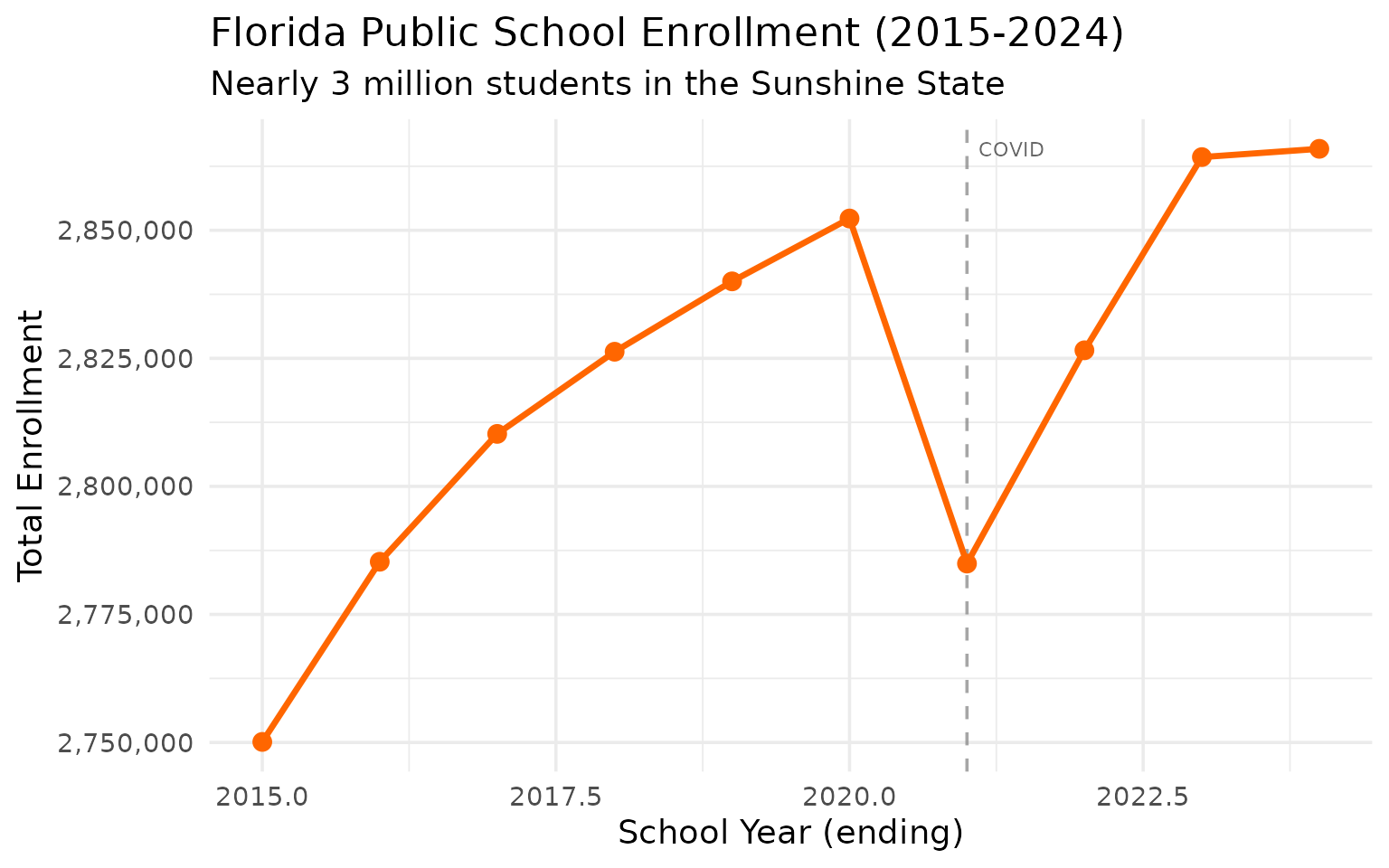
5. Miami-Dade is larger than most states
Miami-Dade County Public Schools, with 340,000+ students, is the fourth-largest school district in America.
enr_2024 <- fetch_enr(2024, use_cache = TRUE)

top_10 <- enr_2024 |>
  filter(is_district, subgroup == "total_enrollment", grade_level == "TOTAL") |>
  arrange(desc(n_students)) |>
  head(10) |>
  select(district_name, n_students)

top_10
stopifnot(nrow(top_10) > 0)
#>    district_name n_students
#> 1     MIAMI-DADE     337610
#> 2        BROWARD     251397
#> 3   HILLSBOROUGH     224144
#> 4         ORANGE     207695
#> 5     PALM BEACH     191390
#> 6          DUVAL     129083
#> 7           POLK     115990
#> 8            LEE      99952
#> 9       PINELLAS      90969
#> 10         PASCO      85808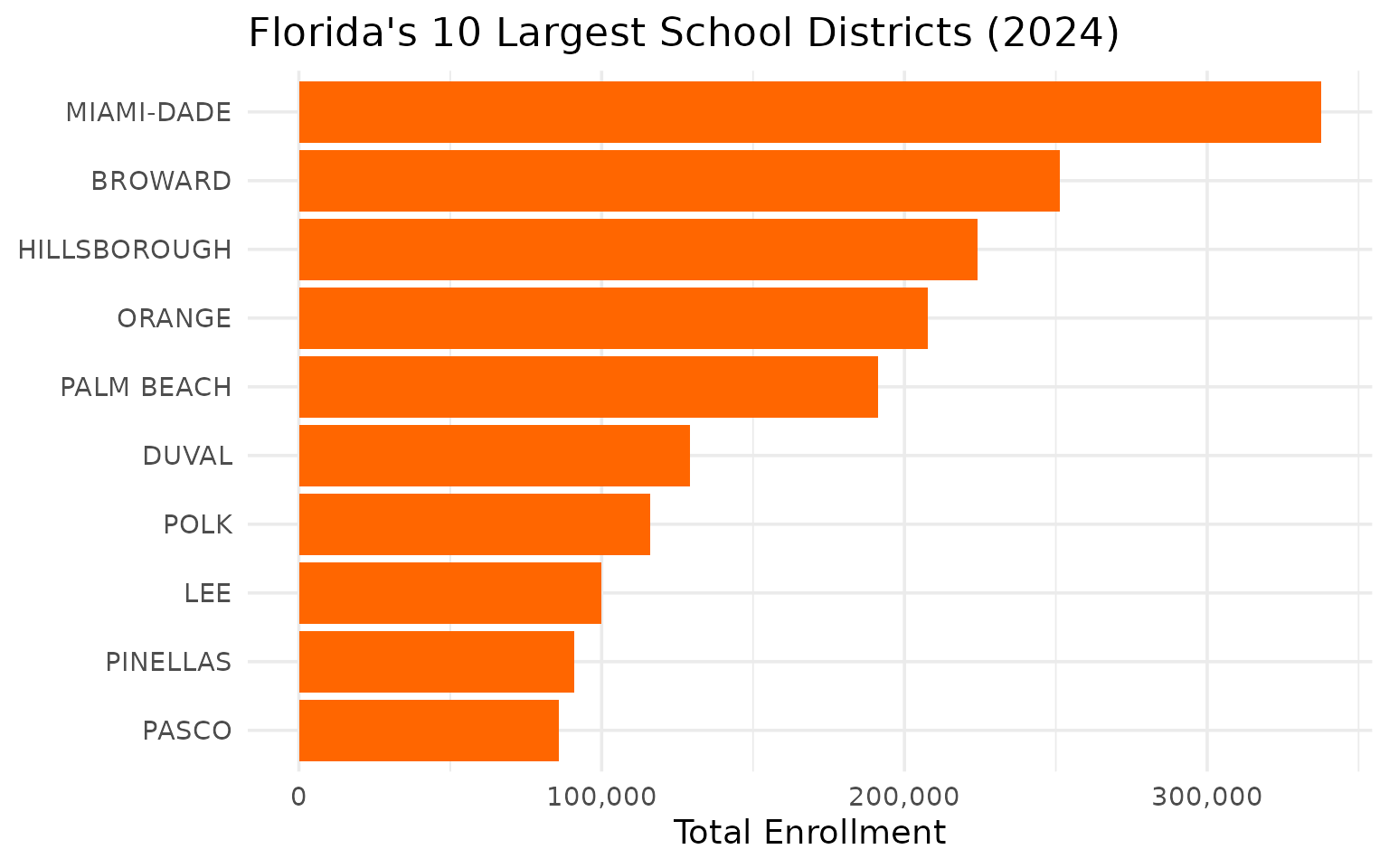
6. COVID barely dented Florida enrollment
While other states saw sharp declines, Florida’s enrollment dipped only briefly in 2021 and has since rebounded.
covid <- enr |>
  filter(is_state, subgroup == "total_enrollment", grade_level == "TOTAL",
         end_year >= 2019) |>
  select(end_year, n_students) |>
  mutate(change = n_students - lag(n_students))

covid
stopifnot(nrow(covid) > 0)
#>   end_year n_students change
#> 1     2019    2840029     NA
#> 2     2020    2852303  12274
#> 3     2021    2784931 -67372
#> 4     2022    2826573  41642
#> 5     2023    2864292  37719
#> 6     2024    2865908   1616
7. Hispanic students are the plurality
Hispanic students now comprise over 35% of Florida enrollment, surpassing white students.
demographics <- enr_2024 |>
  filter(is_state, grade_level == "TOTAL",
         subgroup %in% c("hispanic", "white", "black", "asian", "multiracial")) |>
  mutate(pct = round(pct * 100, 1)) |>
  select(subgroup, n_students, pct) |>
  arrange(desc(n_students))

demographics
stopifnot(nrow(demographics) > 0)
#>      subgroup n_students  pct
#> 1    hispanic    1066935 37.2
#> 2       white     988822 34.5
#> 3       black     599867 20.9
#> 4 multiracial     119907  4.2
#> 5       asian      81688  2.9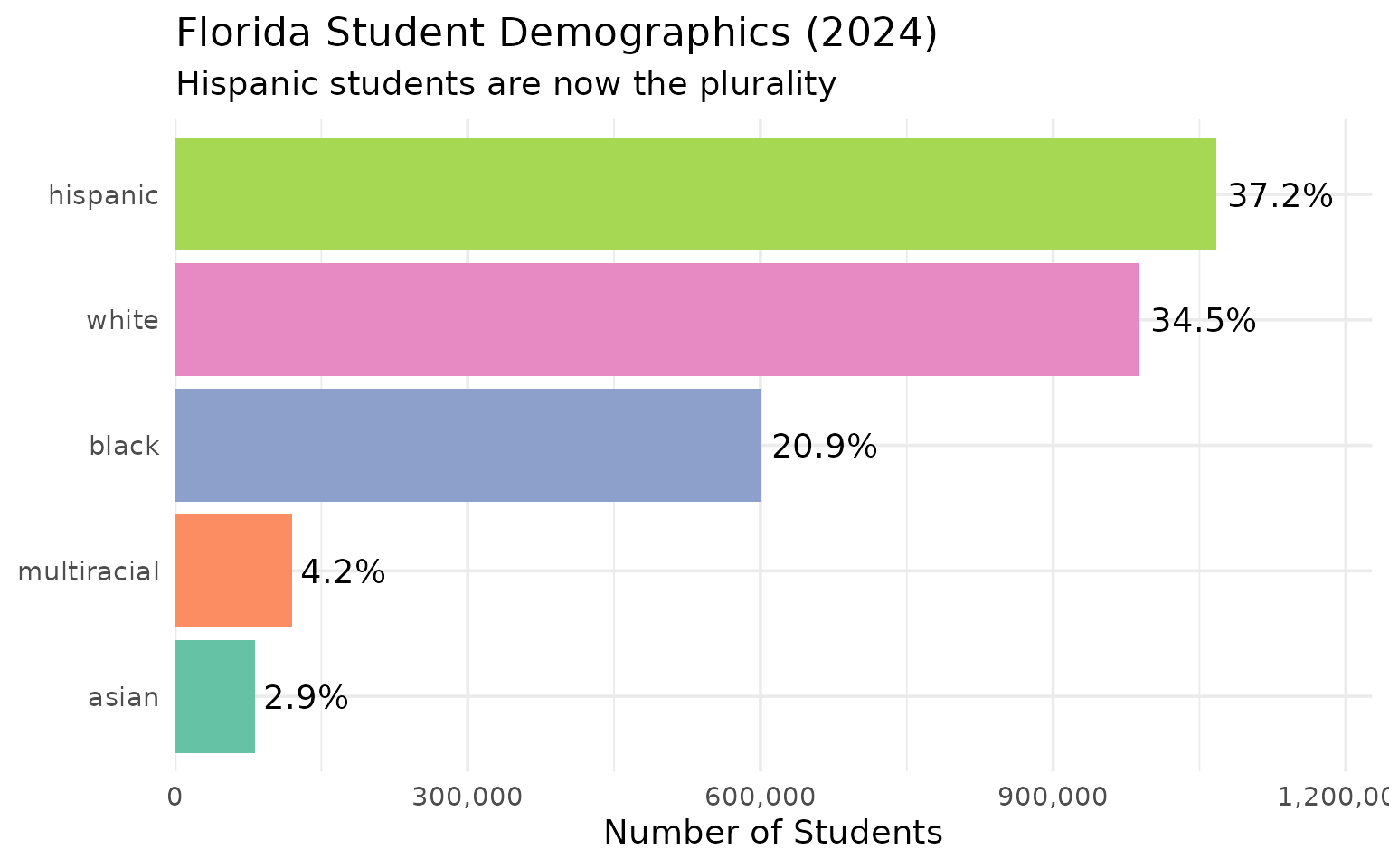
8. Central Florida is the growth engine
Orange, Osceola, and Polk counties have been among the fastest-growing, driven by the Orlando metro boom.
central_fl <- enr |>
  filter(is_district, subgroup == "total_enrollment", grade_level == "TOTAL",
         grepl("Orange|Osceola|Polk", district_name, ignore.case = TRUE),
         end_year %in% c(2015, 2024)) |>
  group_by(district_name) |>
  summarize(
    y2015 = n_students[end_year == 2015],
    y2024 = n_students[end_year == 2024],
    pct_change = round((y2024 / y2015 - 1) * 100, 1),
    .groups = "drop"
  ) |>
  arrange(desc(pct_change))

central_fl
stopifnot(nrow(central_fl) > 0)
#> # A tibble: 3 x 4
#>   district_name  y2015  y2024 pct_change
#>   <chr>          <dbl>  <dbl>      <dbl>
#> 1 OSCEOLA        59276  74278       25.3
#> 2 POLK           99650 115990       16.4
#> 3 ORANGE        191640 207695        8.4
9. Broward and Miami-Dade are declining
South Florida’s two largest districts have been losing students as families relocate.
south_fl <- enr |>
  filter(is_district, subgroup == "total_enrollment", grade_level == "TOTAL",
         grepl("Broward|Miami-Dade", district_name, ignore.case = TRUE),
         end_year >= 2018) |>
  select(end_year, district_name, n_students) |>
  pivot_wider(names_from = district_name, values_from = n_students)

south_fl
stopifnot(nrow(south_fl) > 0)
#>   end_year BROWARD MIAMI-DADE
#> 1     2018  271951     354767
#> 2     2019  270961     350372
#> 3     2020  269163     347239
#> 4     2021  260224     334858
#> 5     2022  256027     329483
#> 6     2023  254728     335831
#> 7     2024  251397     337610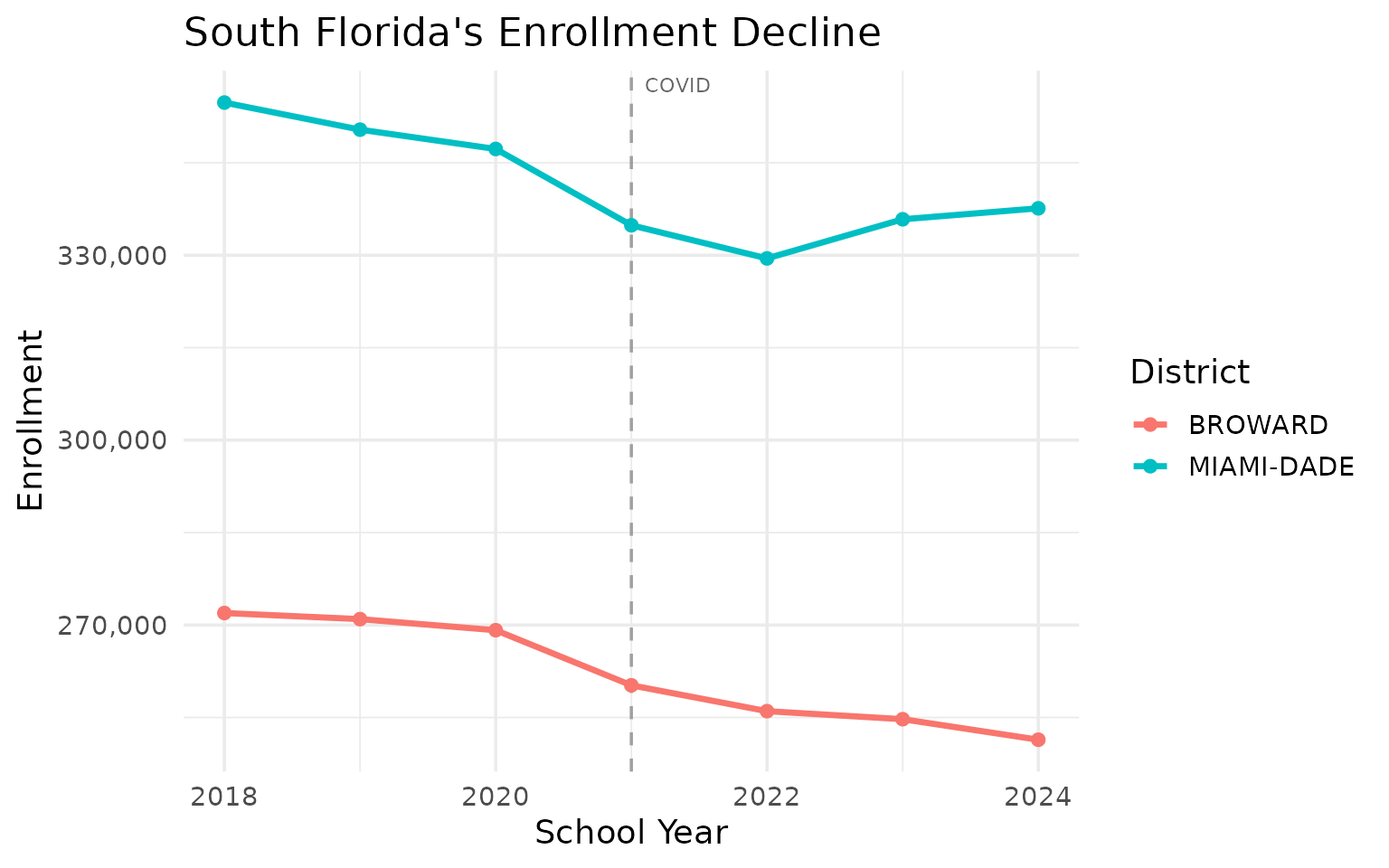
10. Florida Virtual School is a district unto itself
Florida Virtual School (FLVS) serves tens of thousands of students statewide.
virtual <- enr_2024 |>
  filter(is_district, subgroup == "total_enrollment", grade_level == "TOTAL",
         grepl("Virtual|FLVS", district_name, ignore.case = TRUE)) |>
  select(district_name, n_students)

virtual
stopifnot(nrow(virtual) > 0)
#>   district_name n_students
#> 1    FL VIRTUAL       8874
11. Kindergarten is the leading indicator
Florida kindergarten enrollment has been relatively stable, unlike states with sharp K declines.
k_trend <- enr |>
  filter(is_state, subgroup == "total_enrollment",
         grade_level %in% c("K", "01", "05", "09"),
         end_year >= 2019) |>
  select(end_year, grade_level, n_students) |>
  pivot_wider(names_from = grade_level, values_from = n_students)

k_trend
stopifnot(nrow(k_trend) > 0)
#>   end_year      K     01     05     09
#> 1     2019 200437 206545 222947 221023
#> 2     2020 202460 207143 217518 223805
#> 3     2021 186147 200215 207750 227753
#> 4     2022 199099 200741 217770 231499
#> 5     2023 197925 209516 209060 237920
#> 6     2024 195032 204402 205135 232506
12. Black students are 21% of enrollment
Florida has a significant Black student population, concentrated in South Florida and the Jacksonville region.
black_enr <- enr_2024 |>
  filter(is_state, grade_level == "TOTAL", subgroup == "black") |>
  select(subgroup, n_students, pct)

black_enr
stopifnot(nrow(black_enr) > 0)
#>   subgroup n_students       pct
#> 1    black     599867 0.2093113
13. Florida’s county-based system is unique
Florida organizes schools by county, with 67 county districts (plus a few specialty districts). This structure differs from most states.
county_count <- enr_2024 |>
  filter(is_district, subgroup == "total_enrollment", grade_level == "TOTAL") |>
  summarize(
    n_districts = n_distinct(district_name),
    total_students = sum(n_students, na.rm = TRUE)
  )

county_count
stopifnot(nrow(county_count) > 0)
#>   n_districts total_students
#> 1          76        2865908
14. Tampa Bay is catching up to South Florida
Hillsborough and Pinellas counties represent Florida’s other major metro area. While South Florida declines, Tampa Bay has held steady.
tampa <- enr |>
  filter(is_district, subgroup == "total_enrollment", grade_level == "TOTAL",
         grepl("Hillsborough|Pinellas|Pasco", district_name, ignore.case = TRUE)) |>
  group_by(district_name) |>
  summarize(
    y2015 = n_students[end_year == 2015],
    y2024 = n_students[end_year == 2024],
    pct_change = round((y2024 / y2015 - 1) * 100, 1),
    .groups = "drop"
  ) |>
  arrange(desc(y2024))

tampa
stopifnot(nrow(tampa) > 0)
#> # A tibble: 3 x 4
#>   district_name  y2015  y2024 pct_change
#>   <chr>          <dbl>  <dbl>      <dbl>
#> 1 HILLSBOROUGH  207457 224144        8
#> 2 PINELLAS      103754  90969      -12.3
#> 3 PASCO          69218  85808       24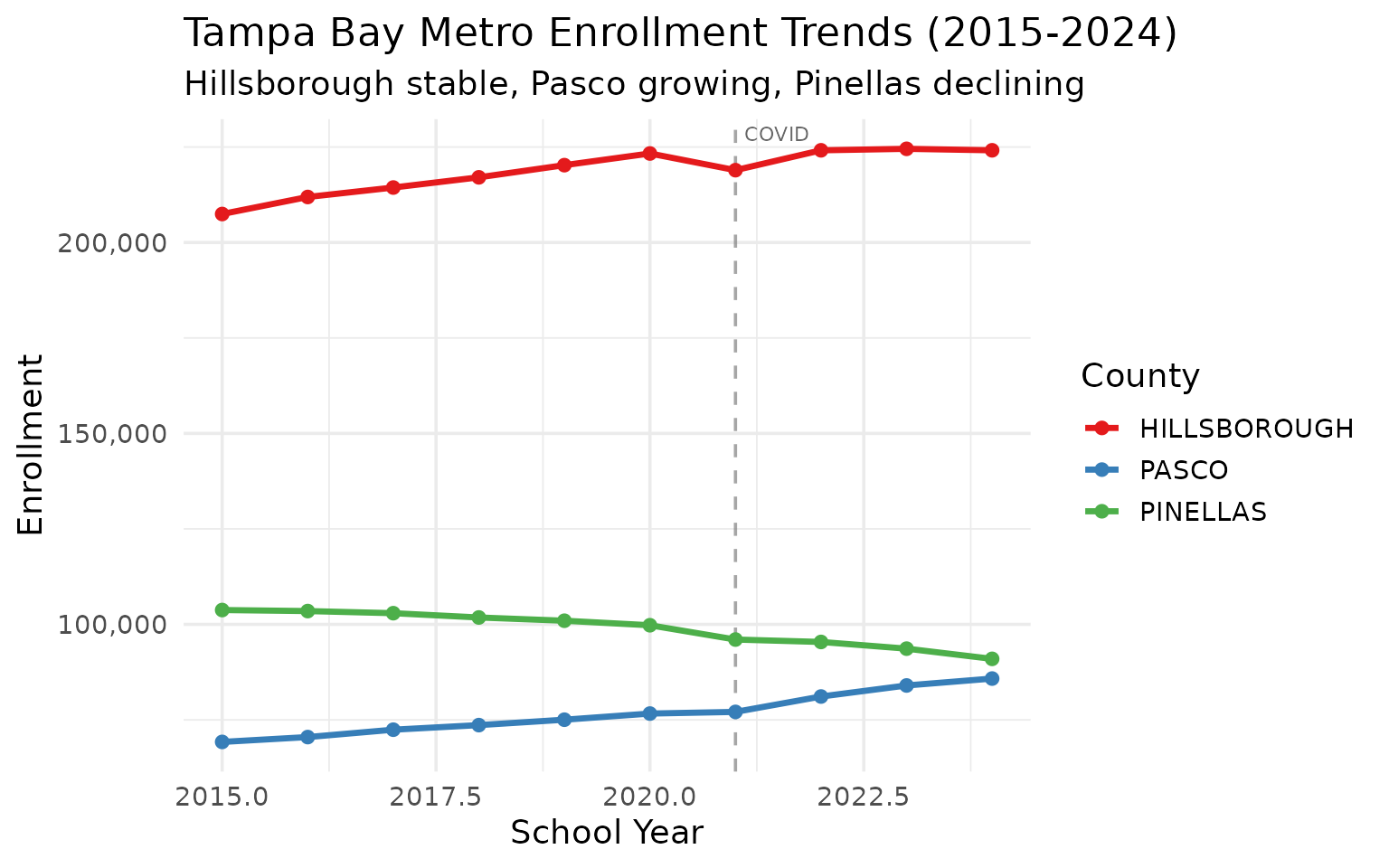
15. Jacksonville is Florida’s hidden giant
Duval County (Jacksonville) often flies under the radar, but it’s Florida’s 6th largest district with over 125,000 students.
jax <- enr |>
  filter(is_district, subgroup == "total_enrollment", grade_level == "TOTAL",
         grepl("Duval", district_name, ignore.case = TRUE)) |>
  select(end_year, district_name, n_students) |>
  mutate(change = n_students - lag(n_students))

jax
stopifnot(nrow(jax) > 0)
#>    end_year district_name n_students change
#> 1      2015         DUVAL     128665     NA
#> 2      2016         DUVAL     129169    504
#> 3      2017         DUVAL     129414    245
#> 4      2018         DUVAL     129562    148
#> 5      2019         DUVAL     130224    662
#> 6      2020         DUVAL     130283     59
#> 7      2021         DUVAL     126802  -3481
#> 8      2022         DUVAL     128939   2137
#> 9      2023         DUVAL     129788    849
#> 10     2024         DUVAL     129083   -705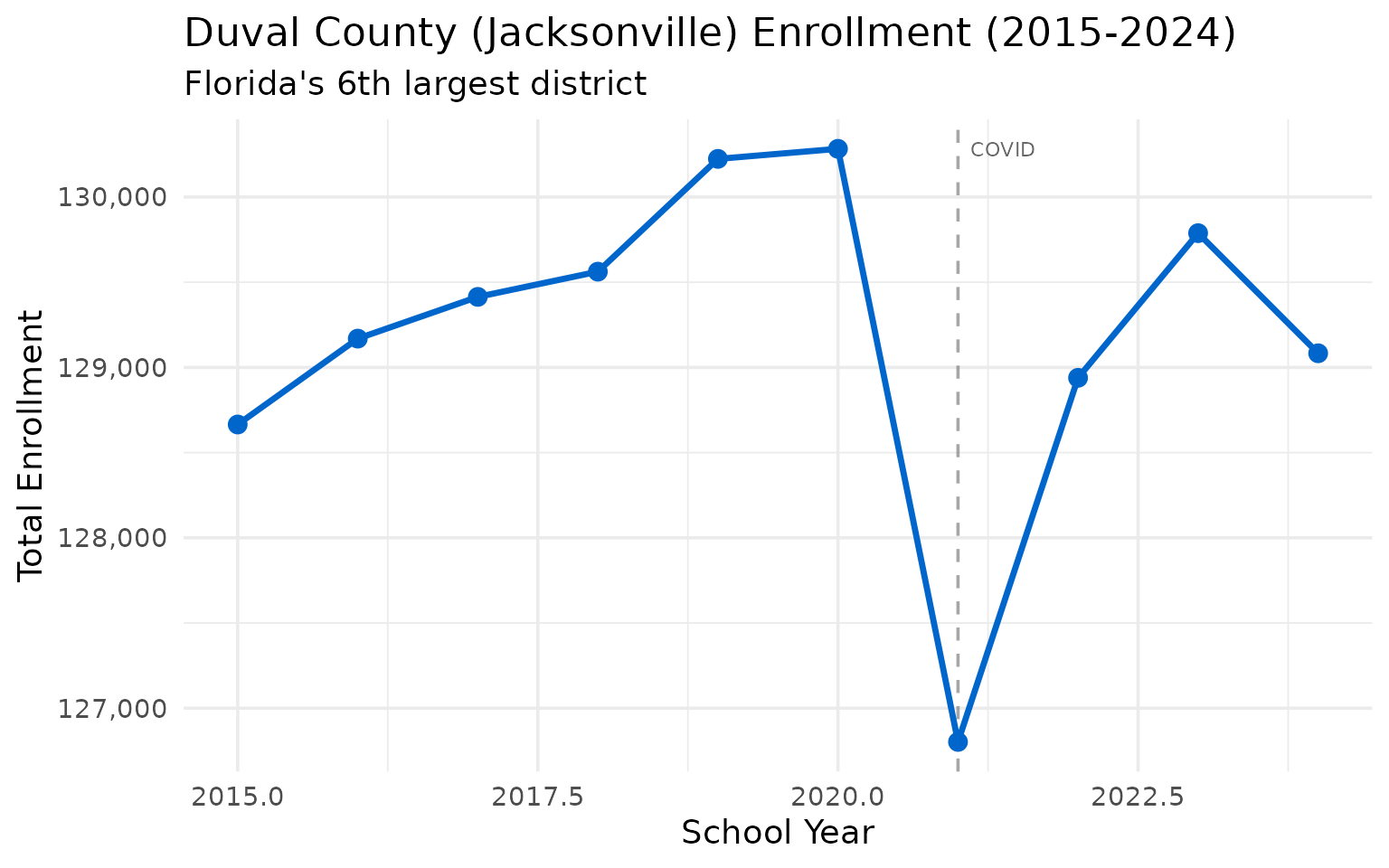
16. Small rural counties face steep declines
While large metros grow, many of Florida’s smallest counties are losing students rapidly.
# Get the first and last year for comparison
first_year <- min(enr$end_year)
last_year <- max(enr$end_year)

county_change <- enr |>
  filter(is_district, subgroup == "total_enrollment", grade_level == "TOTAL",
         end_year %in% c(first_year, last_year)) |>
  group_by(district_name) |>
  filter(n() == 2) |>  # Only counties with both years
  summarize(
    y_first = n_students[end_year == first_year],
    y_last = n_students[end_year == last_year],
    change = y_last - y_first,
    pct_change = round((y_last / y_first - 1) * 100, 1),
    .groups = "drop"
  )

# Counties losing the most (by %)
declining <- county_change |>
  filter(y_first > 1000) |>  # Exclude tiny counties
  arrange(pct_change) |>
  head(10)

declining
stopifnot(nrow(declining) > 0)
#>    district_name y_first y_last change pct_change
#> 1        GADSDEN    5837   4598  -1239      -21.2
#> 2        LIBERTY    1330   1156   -174      -13.1
#> 3       PINELLAS  103754  90969 -12785      -12.3
#> 4      LAFAYETTE    1132   1007   -125      -11.0
#> 5        MADISON    2498   2228   -270      -10.8
#> 6        JACKSON    6726   6037   -689      -10.2
#> 7         DESOTO    4658   4199   -459       -9.9
#> 8         HARDEE    5095   4598   -497       -9.8
#> 9         TAYLOR    2885   2602   -283       -9.8
#> 10       CALHOUN    2149   1942   -207       -9.6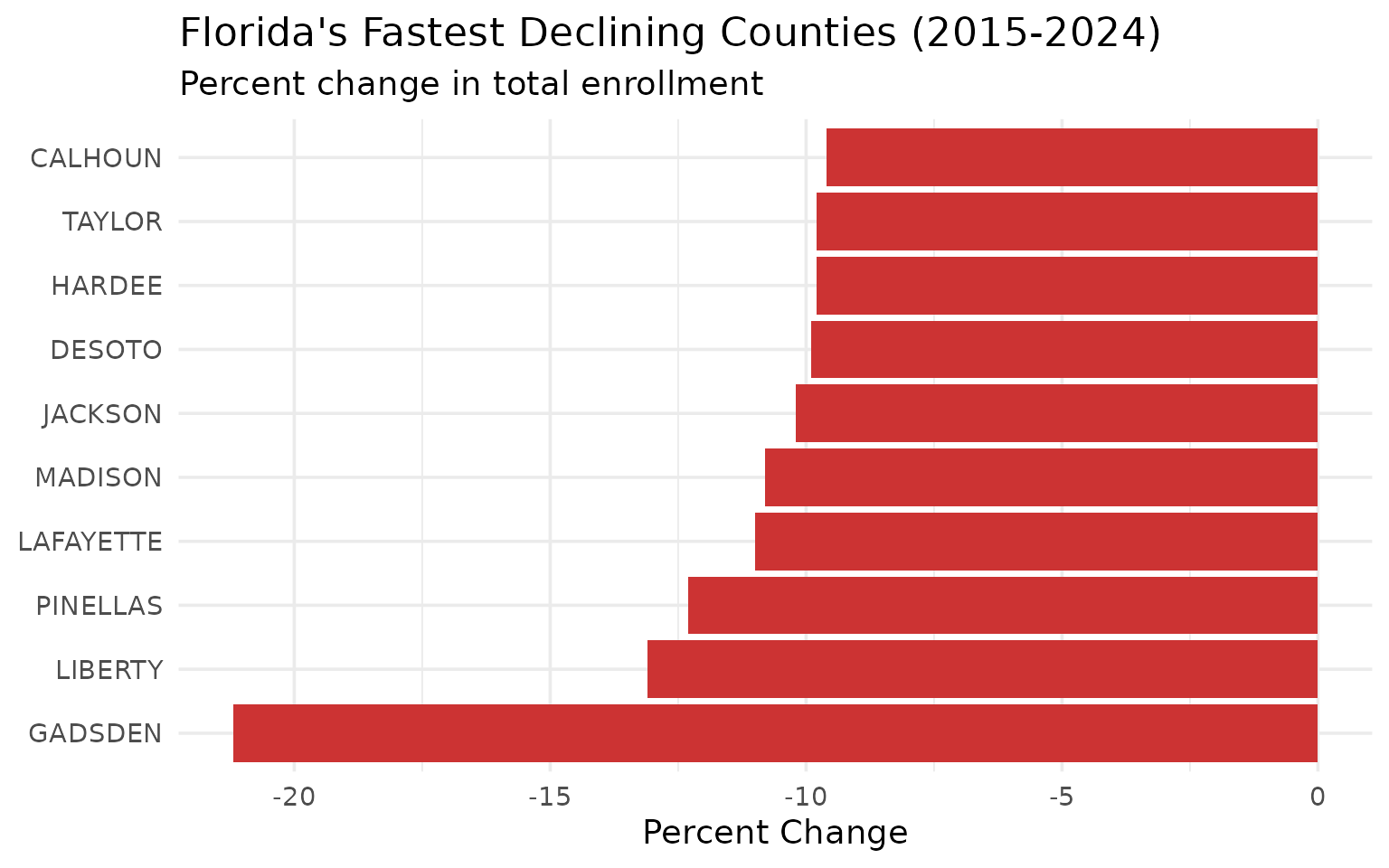
17. Miami-Dade outperforms the state average
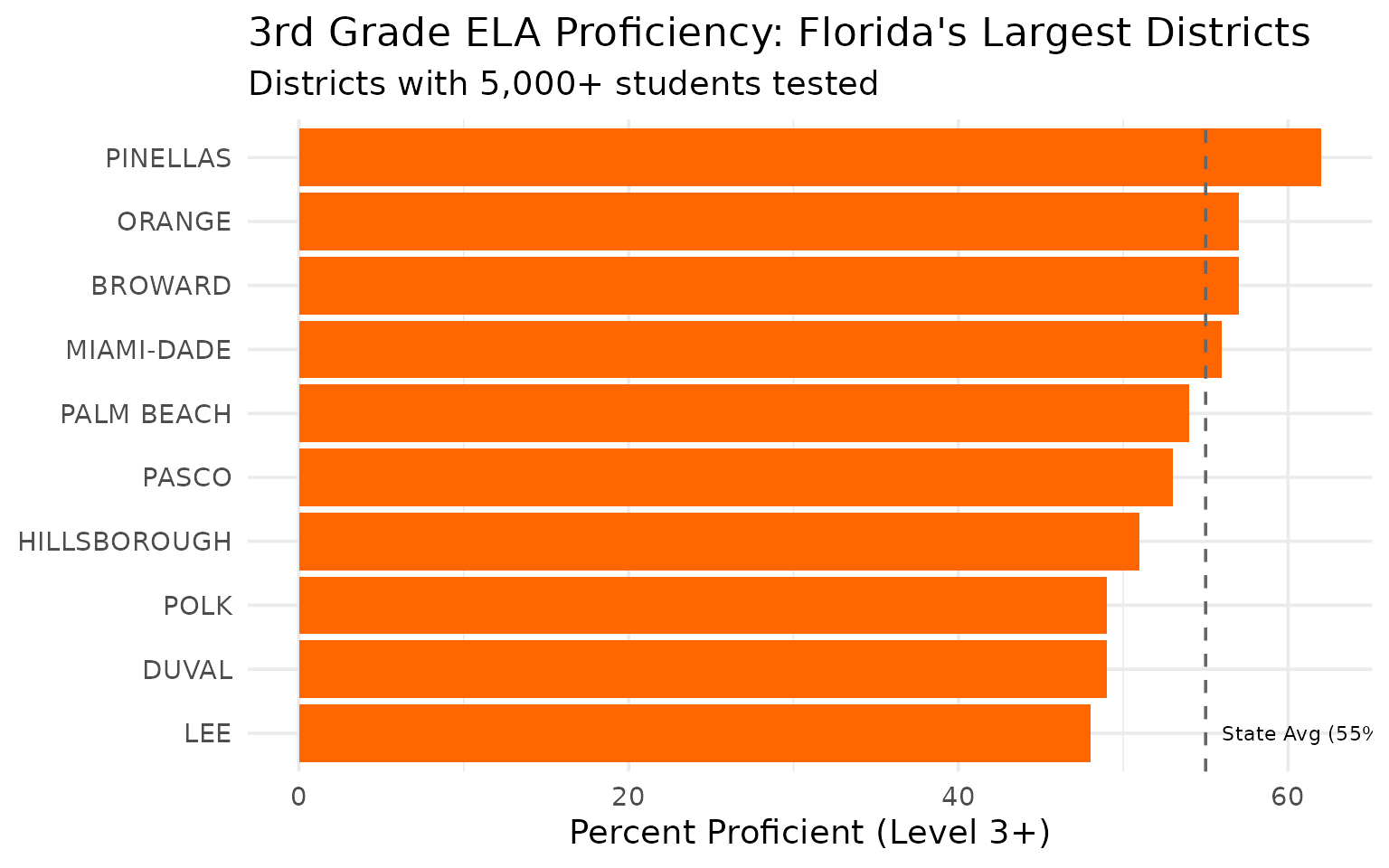
Despite being the largest district with over 25,000 3rd graders tested, Miami-Dade’s 56% proficiency rate exceeds the state average.
large_districts <- assess_2024 |>
  filter(!is_state, n_tested > 5000) |>
  arrange(desc(n_tested)) |>
  select(district_name, n_tested, pct_proficient) |>
  head(10)

large_districts
stopifnot(nrow(large_districts) > 0)
#>    district_name n_tested pct_proficient
#> 1     MIAMI-DADE    25178             56
#> 2        BROWARD    18457             57
#> 3   HILLSBOROUGH    16802             51
#> 4         ORANGE    15743             57
#> 5     PALM BEACH    14593             54
#> 6          DUVAL    10095             49
#> 7           POLK     9295             49
#> 8            LEE     7644             48
#> 9       PINELLAS     6654             62
#> 10         PASCO     6511             53